Three Wells
He told them at supper, because there was no other time when they were all in one room and none of them could leave.
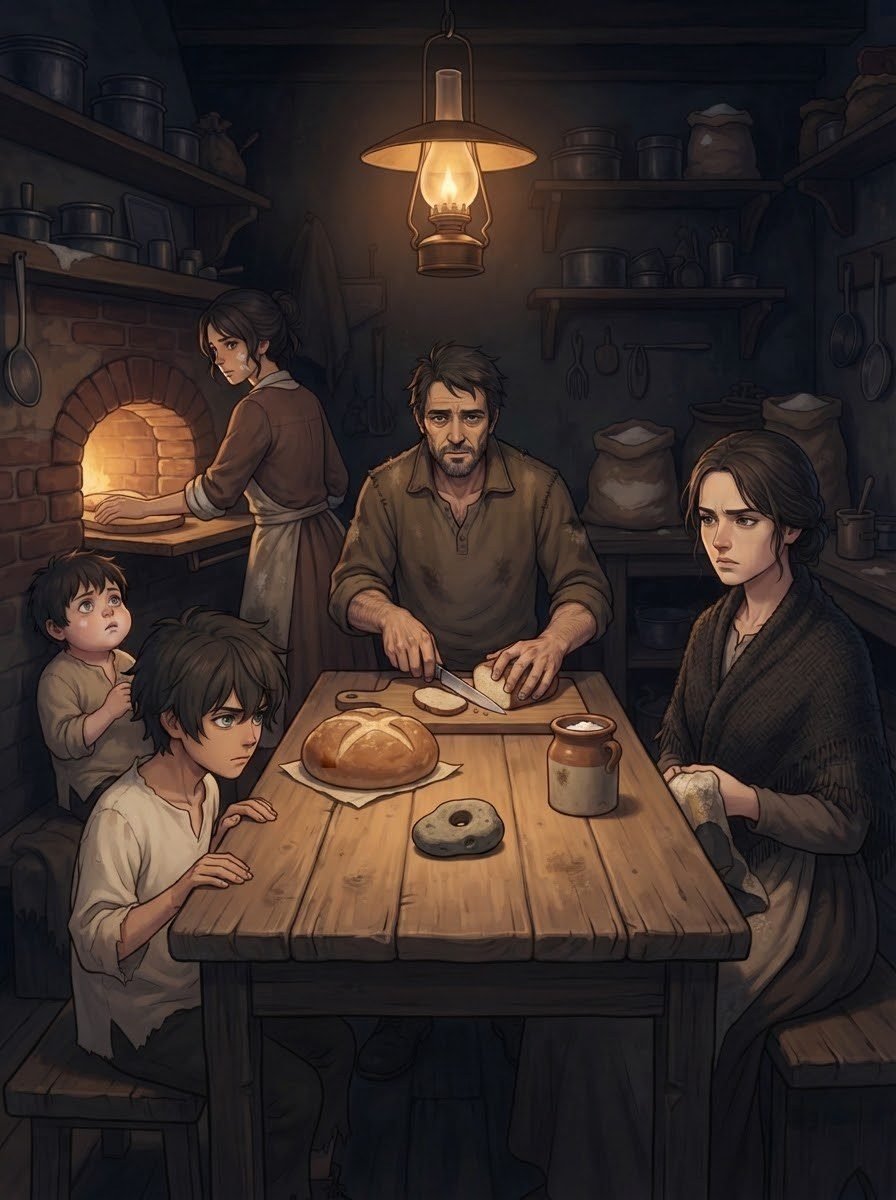
Supper in the Calder house was bread, because supper in the Calder house was always bread, with whatever went with it that day: onions from the yard, a twist of salt, on good days a bowl of the lentil broth Mira kept on the back of the oven where the heat was low. Tonight was a good day. Ash had come home with a stone in his pocket and a torn sleeve and a story, and Pim had made him tell the story four times, and on the fourth telling the awning had been on fire.
Ash put the stone on the table.
It sat there between the bread and the salt, grey, with its hole in the middle, catching the lamplight. Pim stopped chewing. Bette, who had been mending his sleeve in her lap while she ate, looked up and then down again very quickly, the way you look away from someone about to fall.
“That’s for the house,” said Mira.
“It’s for the Tournament,” said Ash.
The room went quiet. It was not a large room and it did not take long.
His father had stopped with a piece of bread halfway to his mouth. He put it down on the board, carefully, as if it might break.
“No,” Hollis said.
“Da—”
“No.”
“The purse is four anchors.” Ash had practised this. He had practised it all afternoon in his head, walking home from the Cut, and it had sounded much better there. “The Stitchery is three. The mender said three. That leaves one for the month after. That’s everything. That’s the leg. That’s—”
“I know what it is.”
“Then—”
“I said no.” His father did not raise his voice. Hollis Calder had never raised his voice in Ash’s memory, not once. He did not need to. He had a way of putting words down like stones on a road, one after the other, so you could see exactly where they went and that they were not going to move. “You want to know why, I’ll tell you why. Then we won’t talk about it again.”
Pim looked from one of them to the other. Mira had not moved at all.
“Two winters ago,” Hollis said, “when the north face came down at Pitch End, there were eleven of us under it. Me and ten others. They dug me out first because I was at the edge. I was lying on a board in the quarry yard with my leg the wrong shape, waiting for the bone-setter, and you know what I could hear?”
Nobody answered.
“The bell. The Ketterford bell. They were holding a market-day climb that afternoon, the Kites were, one of their little games for the crowd, ringing the old bell from the bottom with a rope. And they didn’t stop.” He looked at the table. “Two men died under that face. Dav Orry and the younger Strake boy. They were still under it when I heard that bell ring. And the town was in the square cheering a boy for pulling a rope.”
Ash said nothing. He had not known that. He had been fourteen that day, and he had been in the square. He remembered the bell. He did not remember anything else about it at all.
“I don’t hate the games,” Hollis said. “I’m not a fool. They keep the peace. They keep the bread fair. But a town that can cheer a bell while men are under the rock has its eyes on the wrong thing, and so does any boy who thinks a bell will fix his father.” He picked the bread up again. “I’ll walk crooked. Men have walked crooked before. You’ll stay whole. That’s the end of it.”
He ate his bread. After a moment, so did everyone else, because there was nothing else to do.
The stone sat on the table between them all through supper. Nobody touched it. When Mira cleared the board she lifted it with two fingers, as if it were hot, and put it on the shelf by the door, beside the salt crock, and left it there.
Bette came up the ladder after the lamp was out.
Ash heard her before he saw her: the creak of the third rung, which she always forgot, and then the whisper of her skirt. Pim was asleep, or pretending, his breath going in and out in a deliberate way that meant he was listening with his whole body. Bette crouched beside Ash’s bed in the dark. She was nineteen, three years older than him, and she had their mother’s face and their father’s way of looking at you as though you were a seam that had gone crooked.
She held something out. He felt it pressed into his hand. Round, flat, with a hole in the middle.
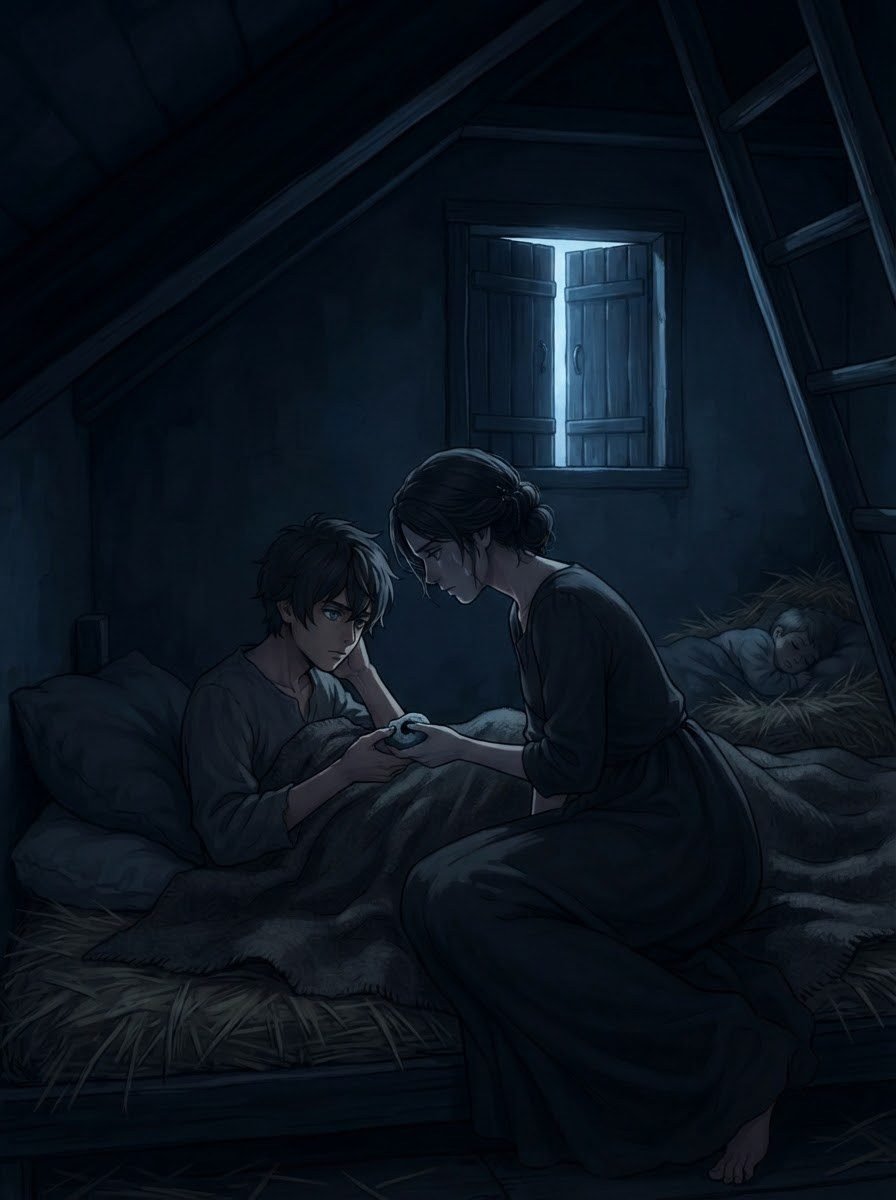
“Mum put it by the salt,” Bette said. “She put it by the salt so you’d see it every time you went out the door. You know that, don’t you?”
Ash closed his hand on the stone.
“She’ll never say yes,” Bette went on. “And Da won’t. But she put it where you’d see it.” She was quiet a moment. “How much is entry?”
“Five stones.”
“By when?”
“The eve of Stone Day. Twenty-six days.”
Bette made a small sound, half a laugh, in the dark. “You’ve got one. You need four more in twenty-six days. From what? Running bread?”
“Market games. There’s a game on every stall. Somebody wins them.”
“Somebody wins one in fifty. The stalls win the rest. That’s why they’re stalls.” She was quiet again. Then she said, “All right.”
“All right what?”
“All right, I’m in. Somebody has to keep your money or you’ll lose it on the first rope trick some old fraud waves at you.” She poked his chest with a finger hard enough to hurt. “Here’s how it goes. Every grit you win, you give to me. Every grit you want to spend, you ask me. I write it down. I keep a slate. The day you lie to me about one grit, I go downstairs and tell Da everything, and then you can explain it to him yourself.”
“Bette—”
“And you don’t die.” Her voice had changed. “That’s the other rule. You enter that tournament, you don’t go and die on that tower. Because if you do, I’ll have to be the one who tells Mum, and I’ll never forgive you. Never. Not even after.”
Ash lay there in the dark with the stone in his fist.
“All right,” he said.
“All right.” Bette stood up, banged her head on the beam, swore under her breath in a way their mother would not have liked, and went back down the ladder.
From the straw sack in the corner, Pim whispered, “I won’t tell.”
“Go to sleep, Pim.”
“I won’t, though. I won’t tell anybody.”
“I know.”
A long pause.
“Ash. When you win, can I have the chalk they use to write your name?”
In the morning, before the oven was hot, Ash went back to the Cut.
He told himself it was to look for the grit that had fallen out of his pocket when he fell, which was true. A grit was a grit. But he did not look for the grit. He went straight to the place under the broken paving, and he climbed down into the leaves, and he looked at the wall.
The spiral was gone.
Not gone. Covered. Someone had come in the night with a bucket of lime mortar and a trowel and plastered the face of the old block smooth, a neat grey patch the size of a man’s chest, still damp at the edges. They had been careful about it. They had even rubbed a little dirt into the wet mortar so it would not look so new. If he had not known it was there, he would have walked past it without a glance.
The broken slab had been cleared away. A new one lay across the top of the Cut in its place, solid and whole, the kind of grey paving stone they used on the Keepers’ hall steps.
Ash stood in the leaves and looked at the patch for a long time.
Then he climbed out and walked round to the north side of the market, past the chandlers and the tinsmith, to the corner where the rope-seller sat every day of the year on his stool beside his coils of hemp.
The stool was there. The coils were there, under an oiled cloth.
The rope-seller was not.
Bette kept the slate under her sewing basket, and she kept it the way the Keepers kept their score book: in columns, in a hand so neat it looked printed, and without mercy.
The first line said Bread Run, won: 1 stone. The second line, written the next evening, said Egg Ladder, won: 4 grit. Egg Ladder, entry: 1 grit. And under that, in smaller letters, as if she did not want to say it too loudly: He counted the rungs first. Nobody counts the rungs.
The Egg Ladder belonged to a cheerful egg-woman from the Mill Road who set it up against the side of her cart every market day. You climbed a ladder to the top with a raw egg balanced on a wooden spoon held in your teeth, rang a little brass bell nailed to the top rail, and came down again with the egg still on the spoon. A grit to try. Five grit if you did it. Children tried it all day long and every one of them broke the egg on the fourth rung.
Ash had watched them for a whole morning before he paid his grit, and he had seen why. The fourth rung was a hand-width higher than the third. Not much. Just enough that a climber who had found his rhythm on the first three reached for the fourth where it should have been, found nothing, jerked, and lost the egg. The egg-woman had built the ladder herself, cheerfully, and cheerfully put one rung wrong.
Ash had counted the gaps from the ground, climbed slowly, reached high for the fourth, rung the bell, and come down with an egg so unbroken that the egg-woman insisted on giving it to him as well. Bette wrote that down too. 1 egg.
The third line was worse.
Knot Race, lost: 2 grit.
The Knot Race belonged to a sailor-looking man with a Weirlands accent who claimed he had tied knots on canal barges for twenty years. He sat behind a table with a thick hemp knot on it, a great tangled fist of rope, and he offered four grit to anyone who could untie it in the time it took him to drink a cup of tea. Ash had found the working end in the first breath. He had worked it loose, one turn, two turns, three, and then come to a turn that would not move however he pulled it. He had pulled until his fingers bled. The sailor had finished his tea and smiled and taken his grit.
Later, when the stall was packing up, Ash had walked past and seen the man pick up the knot and drop it, carelessly, into a pot of something on his brazier. Pine glue, from the smell. The knot was glued at its heart. It had always been glued. Nobody could untie it, and the sailor knew it, and the whole market knew it too, probably, except the people who paid.
“Told you,” Bette said when he came home. “The stalls win. That’s why they’re stalls.”
“Not all of them.”
“Most of them.”
“Then I’ll find the ones that don’t.”
She wrote: Knot Race. Glued. Never again. She underlined never twice.