Three Wells

The days went by the way market days do, all at once and very slowly.
He found the ones that didn’t. Or rather, he found that almost every stall had a weak place, if you watched long enough, the same way every roof had a loose slate. The trick was not to be clever. The trick was to be patient, which was a thing nobody who paid one grit for a game ever was. They walked up, they paid, they played. They did not stand at the side for an hour watching other people lose.
Ash stood at the side for hours.
He stood by the Weigh-In, where a red-faced farmer from Tallow Cross offered six grit to anyone who could guess the weight of his goat to the nearest pound. He watched the farmer’s grown son wander up, apparently a stranger, and guess wrong on purpose, and walk off, and come back an hour later in a different hat. He watched the goat. It was a fat goat. Then he went and looked at the farmer’s scales, behind the stall, the ones he used to weigh the goat for the judges at the end, and saw that the scales were his own and not the Warden’s.
So Ash did not guess the goat’s weight at all. He went to the Warden’s man in the Keepers’ hall and asked, very politely, whether the town scales could be borrowed for a weighing in the market, for fairness, and the Warden’s man, who was bored, sent a boy with them. And the goat on the Warden’s scales weighed nine pounds less than the goat on the farmer’s scales had weighed every day for a month, and Ash’s guess, which he had made by guessing the goat and then taking away nine pounds, was the nearest anyone had ever come.
The farmer paid him the six grit with a face like a wet boot. Bette wrote it down.
He tried Penny Archery, at the stall where three pennies swung on strings from a bar and you had three arrows from a short bow to hit them. He hit nothing. He hit a passing chicken, very nearly. He decided he would never be an archer and that this was fine.
He tried the Hot Bench, and won, and could not sit down for two days. He tried the Riddle Post, where three riddles were nailed up every week and you won a grit for each you answered, and won three grit, and found out later that Pim had already known all three answers from listening to old men at the well, and was so furious that Pim had not told him that he did not speak to him for a whole morning.
By the ninth day, Bette’s slate said: Total: 2 stones, 3 grit.
Two stones. Three to go. Seventeen days left.
It was not enough. He could feel it was not enough, the way you can feel a ladder is too short before you reach the top of it. Market games paid grit. He needed stones. He needed a game that paid in stones, and there was only one stall in the Fourway Market that did.
The Three Wells stood on the south side of the square, between the dyer and the knife-grinder, and it had a crowd around it every hour of every market day.
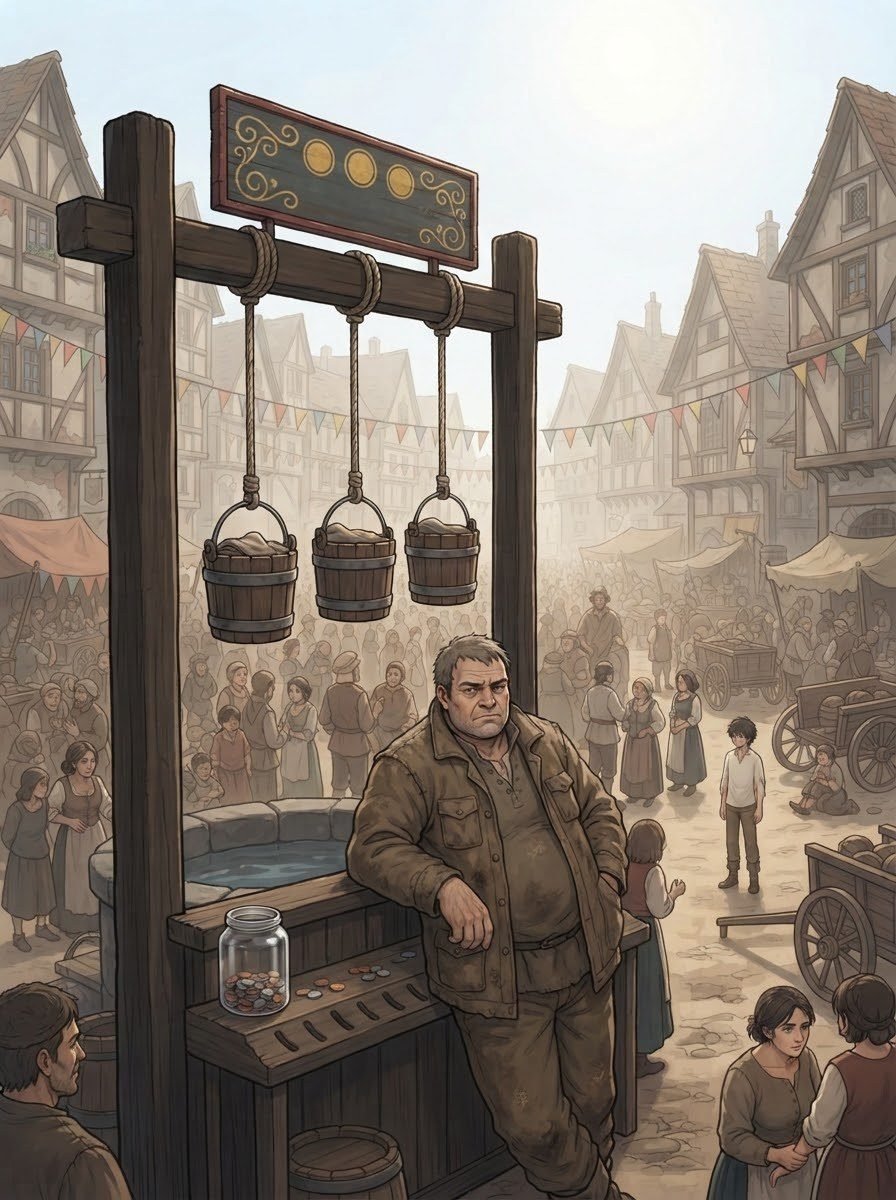
It was a handsome stall. Its owner had clearly spent money on it. A tall frame of dark wood held up a crossbeam, and from the crossbeam three wooden buckets hung on three ropes, side by side, each one covered with a square of red cloth so you could not see inside. Above the beam, a painted board hid the top of the frame and the ropes where they ran over it. The board said THREE WELLS in gold letters, and underneath, in smaller letters: ONE WATER, TWO SAND. FIND THE WATER, WIN THE POT.
You paid two grit. You chose a bucket. The stall-keeper handed you the end of that bucket’s rope, which hung down through a slot in a low wooden shelf in front of the frame, and you pulled. The bucket rose. The keeper lifted the red cloth. If it was water, you won the pot.
And the pot was the thing. Every two grit paid went into a glass jar on the shelf, where the whole market could see it growing. No one had found the water in eleven days. The jar now held two stones and ten grit.
Two stones and ten grit. In one pull.
The stall-keeper was a broad man with a broad smile and broad hands and small, quick, colourless eyes. He had a mud-coloured jacket. Ash had seen that jacket before, twice, on two boys from Cobble Down.
“Dace Mallory,” said Quent Hobb at his elbow, as if he had grown out of the cobbles. “Uncle to the two you know. He’s a Cobble Down man too. Paid the Warden for a pitch here this summer. Doing very nicely.”
“One grit for the air?” said Ash.
“That one’s free.” Quent grinned. “Because I like watching you lose.”
He vanished. Ash stayed.
He stood across the square, by his mother’s stall, where he could sell bread and watch at the same time, and he watched the Three Wells for an hour. Then two. Mira looked at him sideways and said nothing, which was how Ash knew she knew exactly what he was doing.
He watched the buckets.
They looked the same. Same size, same wood, same red cloths. But a bucket of water and a bucket of sand are not the same thing to a rope, and Ash’s father had spent twenty years hauling loads up out of quarry pits on ropes, and Ash had grown up hearing about ropes the way other boys heard about weather. Wet hemp stretches. Wet hemp darkens. A rope that’s been in water hangs lower, every time, by a finger or two, and goes the colour of strong tea where the wet climbs up it from the knot.
And one of those three ropes, every time the buckets were reset, was darker at the bottom than the other two. And that bucket hung lower. By a finger. Not much. Just enough.
So why did no one ever win?
Ash watched the players. A carter. A girl with a basket. Two Tallow Road boys, daring each other. Each of them pointed at a bucket. Some of them, by luck, pointed at the low one, the one with the dark rope. And each time, Dace Mallory smiled his broad smile and said “Your rope, friend,” and bent to the shelf, and lifted a rope end out through its slot, and put it in the player’s hand.
And each time the player pulled, and a bucket rose, and the red cloth came off, and it was sand.
Ash stopped watching the buckets. He watched the rope ends instead. The three tails that hung down through the slots in the shelf, and Dace’s hand bending to lift one of them up.
A rope is one piece. Lift one end of it, even a little, and the other end feels it. So when Dace lifted a tail out of its slot, one of the three buckets above should twitch: the cloth on top of it should tremble, just slightly, as the slack came out of its rope. And it did. Every time. But whenever a player had pointed at the low bucket with the dark rope, it was never the low bucket’s cloth that trembled. It was the left one, or the right. Somewhere up behind that gold-lettered board, the ropes crossed. The tail Dace put in your hand was never the rope you had chosen.
He watched for another hour, until he was sure, and then he went home and did not sleep.
“Two grit,” said Bette, “for one pull.”
“For two stones and ten.”
“For one pull at a stall you’ve just told me is crooked.”
“That’s why it’s two stones and ten. Because it’s crooked. Because nobody’s won it.” Ash was sitting on the edge of the yard bench, where their father sat in the mornings. It was very early. The oven was not lit yet. Bette stood in front of him in her shawl with the slate held to her chest like a shield. “If it was honest, someone would have found the water in eleven days. Somebody always does. One in three. It’s not hard. It’s only hard if he’s cheating.”
“And if he’s cheating you won’t win either.”
“I will. If I don’t take his rope.”
Bette looked at him for a long moment. Then she looked at the slate, at all those neat lines, every grit he had sweated for, and she rubbed one corner of it with her thumb.
“Two grit,” she said finally. “Not one more. If you lose, you never go near that stall again.”
“If I lose, I’ll never want to.”
She wrote it down before he went. Three Wells: 2 grit. And then, after a moment, she drew a little line beside it and left the result empty, the way the stonecutter left the top row of the board.