Party of Strangers

Quent’s price was one stone.
“Not now,” he said, perched on the edge of the yard wall behind the Calder house while Ash split kindling below him. “After. If we win, the Kites pay your five stones to the Keepers, and you’ve still got the stone and one grit your sister keeps under her basket. That stone’s mine.”
“How do you know about the basket?”
Quent looked pained, as though Ash had asked how he knew water was wet. “If we lose, I get nothing. That’s fair. I’m a fair man.”
“You’re fourteen.”
“I’m a fair fourteen.” Quent swung his heels against the wall. “There’s no age on the Lantern Hunt. I checked. There’s an age on your tournament, sixteen, so I can’t use the entry, and I wouldn’t want to, because I’ve seen that tower and I like my bones where they are. But I can find a lantern in the dark faster than any lad in this town, and I can open a latch with a bent nail, and I can make a fire in the rain. You’ll need all three.”
“Why would I need to open a latch?”
Quent smiled. “Because the Kites hide lanterns in places you need to open. They always do. Ask anyone who’s run it.”
Ash split a log. He thought about it. He thought about the slate, and 1 stone, 1 grit, and fifteen days.
“Half a stone,” he said.
“One stone.”
“Half, and I don’t tell Nan Tipple who’s been taking chestnuts off the back of her brazier every morning since spring.”
Quent’s heels stopped swinging. He looked at Ash with real respect for the first time.
“Half,” he agreed. “And you’re a worse man than you look.”
Moss was harder.
Moss stood in Grell’s back room with his hands in a trough of dough up to the wrist and his face going slowly redder as Ash explained, and when Ash had finished he shook his head so hard flour came off his hair.
“I’ll knock things over,” he said. “In the dark. I knock things over in the light.”
“I need someone to knock things over.”
“You need someone who can find things. I can’t find anything. I lost my own apron last week. I was wearing it.” Moss pulled his hands out of the trough. “And the tournament. I can’t climb that tower, Ash. I’d pull it down.”
“You don’t have to climb it. You don’t have to win. You just have to enter.”
Moss stared at him.
“The second round’s pairs,” Ash said. “Carry Line. It’s every year. Two people carry a stretcher with a stone on it across the Quarry Road course. I need a partner for that or I’m out in the second round, and there’s nobody in this town I’d rather carry a stone with than you.” He paused. “You walk like me. Have you noticed? We walked down Oven Row together every morning for three years. Same step. I never have to slow down for you, and you never have to wait for me.”
Moss looked down at his feet, as if checking.
“And the top eight get a purse,” Ash went on, which was true, and which he had only found out that morning by reading the small print on the Keepers’ notice twice. “Not four anchors. But a stone each, for getting to the Climb. A stone and the board.”
“The board,” said Moss slowly.
“Top eight get carved on the Tournament board. Small. Under the winner’s line. For one year, till the next lot.” Ash shrugged. “Grell would have to put that in his window. Baked by Moss Barlow, of the Ketterford board.“
Moss stood very still with dough drying on his hands.
“That’s not fair,” he said at last, quietly. “You knew that would work.”
“I hoped.”
Moss sighed, a sigh that seemed to come up from his boots. “I’m not climbing the tower,” he said.
“You’re not climbing the tower.”
“I’ll knock things over.”
“I’m counting on it.”
He did not have a fourth.
He asked the Tallow Road girls, Neve and Orla Pask, who laughed and said they already had a party with their cousins, thank you, and they’d see him at midnight, if he was still standing. He asked Arn from the Mill Road, who was already promised. He asked two lads from the tannery, who said they’d heard about the awning. By the third evening he was running out of people he knew, and the Lantern Hunt was the next night, and the Kites’ hall closed its book at the dusk bell.
He was walking past the north side of the market, thinking about it, when he saw that the rope-seller’s stool was not empty any more.
The old man was back. He sat exactly as he had always sat, with his coils of hemp around his feet and his hands folded on top of a short walking stick, looking at nothing. His coat was the same. His beard was the same. He might never have moved in thirty years.
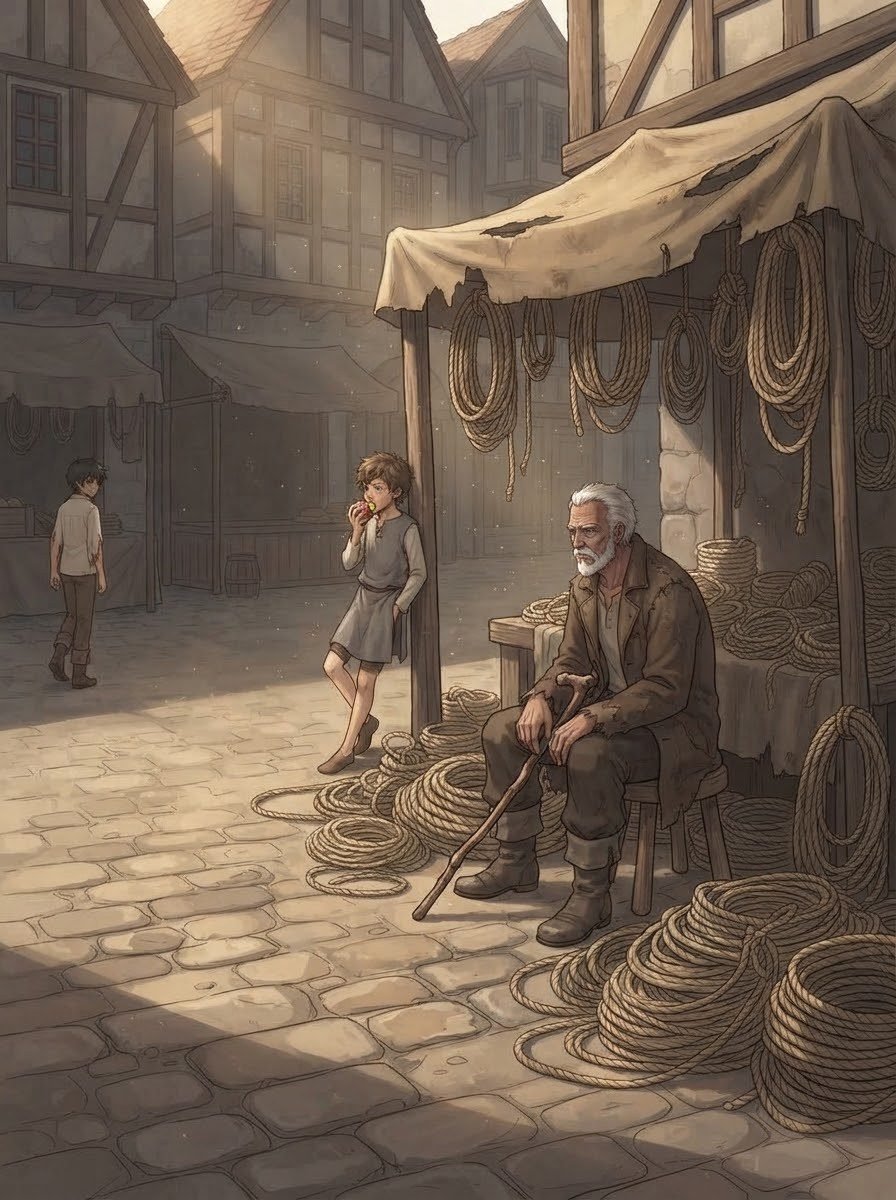
Ash stopped. The rope-seller did not look at him. Ash took a step toward the stool, and the rope-seller’s pale eyes moved, just slightly, to the left, to the corner of the next stall, where a Keeper’s runner in a grey tabard was leaning against a post, eating an apple. Then back to nothing.
Ash kept walking.
He did not know why he did that. He walked all the way round the well and back to Oven Row before he understood that the old man had told him something, without a word, as plainly as if he had shouted it. Not here. Not with them watching.
He was still thinking about it when he ran into Tilda Penn.
Literally ran into her: he came round the corner of the Stitch Room with his head down and she was coming out with an armful of rolled bandages, and the bandages went everywhere, unrolling across the cobbles like white streamers.
“Oh, well done,” said Tilda.
She was seventeen, small and square, with her hair scraped back hard under a mender’s cap and a face that seemed to have been designed for looking unimpressed. Ash knew her a little. Everyone did. She was the Stitch Room’s best apprentice, and she was rude to everyone equally, including the master mender, which was why she was still an apprentice at seventeen and not a journeyman. She had once set a dislocated shoulder on a drunk carter in the middle of the Fourway while telling him in detail exactly how stupid he was, and the carter had thanked her afterwards.
Ash knelt and started rolling bandages.
“Not like that,” said Tilda. “You’re putting dirt in them. Give me that. Go away.”
Ash gave her the bandage. He did not go away.
“You’re entering the tournament,” he said. It was a guess. It was not a hard one: she had a copy of the Keepers’ notice folded into her apron pocket, with one corner sticking out, and it had been folded and unfolded so many times it was soft.
Tilda’s hands stopped. Then they went on rolling, faster.
“What if I am.”
“Why?”
“Why does anyone.” She did not look up. “Not to win. I’m not stupid. I’m a mender, I’m not a climber.” Roll, roll. “The Stitchery in Stoneward sends a mender to watch the Ketterford climb every year. In case of falls. If an apprentice gets through to the top eight, the Stitchery mender writes their name in a book. And the Stitchery takes two apprentices a year from the towns, free, from that book.” Roll. “There’s no other way in for someone like me. The fee’s two anchors a year. My mother washes sheets.”
“You’ve got the entry fee?”
“I’ve got three stones and nine grit,” said Tilda. “I’ve been saving since I was twelve. If I’m careful I’ll have five by the eve.” She snapped the last bandage tight and looked up at last. “Why?”
“Because,” said Ash, “I know a way you could keep all of them.”
She listened to the whole thing without interrupting, which he learned later was the highest compliment Tilda Penn could pay anyone. When he was done she looked at him for a long moment.
“Moss Barlow,” she said. “Quent Hobb. And you.”
“Yes.”
“A baker, a thief and the boy who sat on Pell’s awning.”
“And a mender,” said Ash. “If you want.”
Tilda tucked the bandages under her arm.
“Somebody,” she said, “is going to need stitches.”
The Kites’ hall stood on Bell Lane, the narrow street that ran from the square to the foot of the old tower, and it was the closest thing Ketterford had to a guild house. It had been a granary once. The Kites had painted the doors blue and hung a great faded kite over them, red, with a tail of knotted ribbons that the wind had been working at for twenty years. Inside it smelled of old grain and lamp oil and the sweat of boys who wanted to be players.
The Ketterford Kites were not a real guild. Ash knew that. The real guilds, the great ones whose names the caravan men muttered, were in the cities, up the Ladder; they had halls of stone and armouries and sponsors. The Kites were a town club. They ran the market climbs and the Lantern Hunt and the Kites’ team in the yearly tournament, and they drank in the Weigh House tavern afterwards, and they argued about the old days. But in Ketterford, they were the nearest thing there was to the games, and every boy in town wanted to wear blue.
The book lay open on a trestle table by the door. Behind it, leaning back in a chair with his boots on the table, was Captain Gerrod Mace.
Ash had seen him a hundred times and never this close. He was perhaps twenty-eight, a big man going a little soft at the middle, with a handsome face that had been very handsome once and was now merely handsome, as though it had been left out in the rain. His hair was the colour of straw and his jacket was Kites’ blue, with good brass buttons. And around his neck, on a leather cord, hung a disc of dark metal the size of a palm, stamped with a design Ash could not see from where he stood.
Everyone in Ketterford knew what that disc was. It was the pass to Stoneward. Gerrod Mace had won it six years ago, when he was twenty-two, on the old bell tower, in front of the whole town. They said he had climbed the last stretch with one hand.
And then he had not gone.
Nobody knew why. Some said his mother had been ill. Some said a girl. Some said he had looked down the Stoneward Road on the morning he was meant to leave and decided Ketterford suited him. He had kept the pass, and worn it every day since, and become captain of the Kites, and every year he climbed the tower again in the Tournament for the crowd, and every year he let a younger man ring the bell.
People had a name for that, Ash had heard. Old players in the Weigh House. A pass you never used. A Pocketer, they called a man like that, because his pass lived in his pocket instead of on the road.
Gerrod looked at the four of them standing in front of his table, and his eyebrows went up.
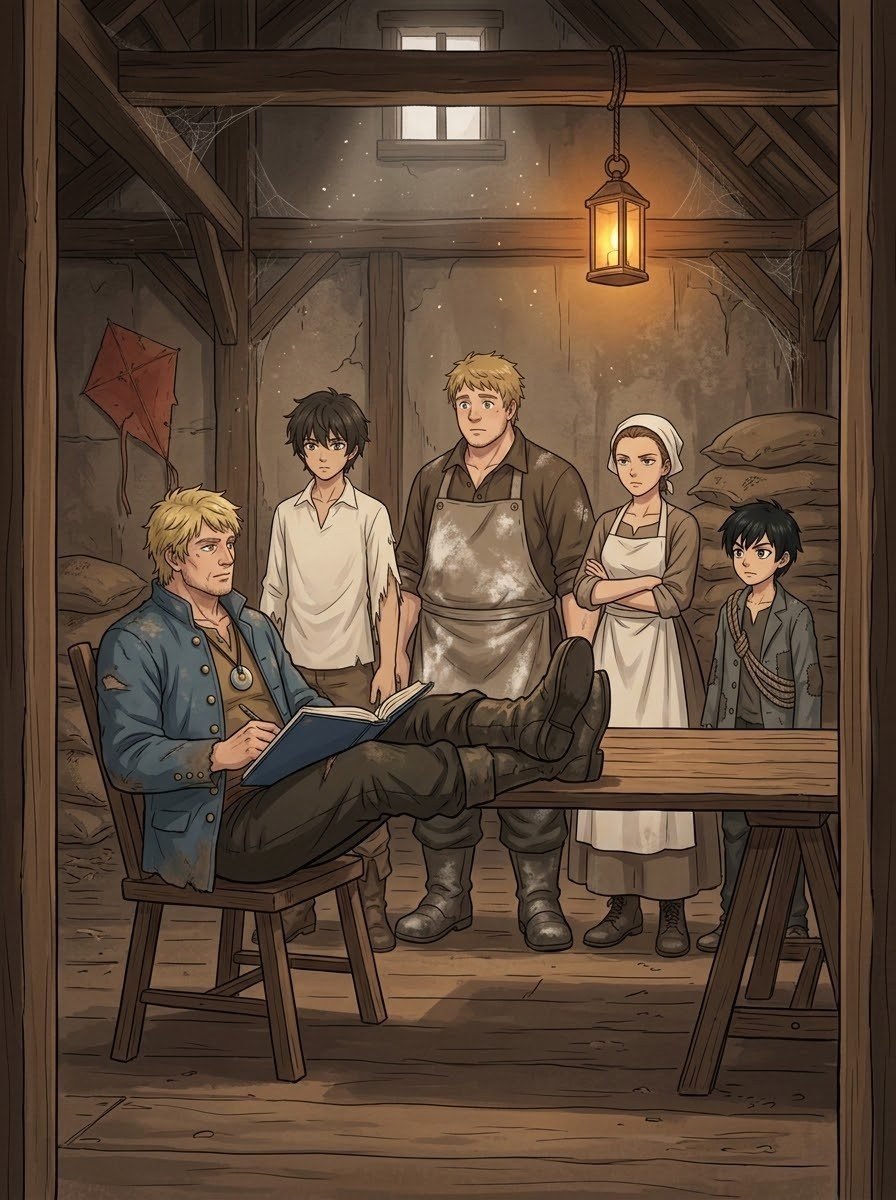
“Well,” he said. “Look what the market’s sent us.”
“Party for the Lantern Hunt,” said Ash. “Four.”
Gerrod took his boots off the table and leaned forward to look at them properly. He looked at Moss, and the eyebrows went higher. He looked at Tilda, who looked back at him as though he were a wound she had been asked to clean. He looked at Quent, and his face did something complicated.
“Hobb,” he said. “Didn’t I bar you from this hall?”
“For a year,” said Quent. “It’s been a year and two days.”
Gerrod looked at him a while longer. Then he laughed, a big easy laugh that filled the old granary, and pushed the book across the table.
“Names,” he said. “And your roles.”
“Roles?” said Moss.
Gerrod sighed, but he sounded pleased, like a man who had been waiting all week for someone to ask.
“A party’s not four people standing near each other,” he said. “Anyone who’s played a real game can tell you that. A party is jobs. Every one of you does one thing, and you trust the others to do theirs.” He counted on his fingers. “Your Scout goes first and finds the way. Your Tank stands between your party and whatever’s coming, and takes the knocks so nobody else has to. Your Healer keeps the Tank standing. And your Support is everything else: light, tools, rope, fire, whatever the job needs that nobody else is carrying. In the cities they’ve got a dozen names for all of it and a school for every one. Here, that’s enough.”
He looked at them. “So. Who’s who?”
They looked at each other.
“Scout,” said Ash.
“Healer,” said Tilda, with a look that dared anyone to argue.
“Support,” said Quent, “for a fee.”
Moss looked at the three of them, and then at Gerrod, and then down at himself, at the sheer size of himself, as though he had just been introduced to it.
“Oh,” he said. “I’m the one who stands in front.”