Party of Strangers
The dusk bell rang from the Keepers’ hall at the turning of the light, and six parties stood in a ragged line at the foot of the old tower with their shadows stretching out behind them across the square.
Ash counted them, out of habit. The Kites’ own junior party, four boys in blue with lanterns of their own already lit, looking bored and certain. Neve and Orla Pask and their two cousins, who had painted their faces with soot for reasons nobody understood. Arn the Mill Road runner and three of his brothers, all thin, all fast, all looking at the ground as if it owed them money. A party of four clerks from the Keepers’ hall, very serious, with a map. A party of tannery lads who smelled like a tannery.
And the Cobble Kings.
Brint and Hask Mallory, and two more Cobble Down boys Ash had never seen, both heavy, both in the same mud-coloured jackets. The Mallorys had not been barred from anything. Their uncle’s stall was closed for inspection; they were not. Brint caught Ash’s eye along the line and smiled, the same slow smile he had given Nan Tipple before the Bread Run, and said nothing.
Gerrod Mace stood on the tower’s bottom step with a lantern in one hand and a sheaf of cards in the other, and the market crowd that had stayed to watch pressed in around the square’s edge.
“Rules,” said Gerrod, and his big voice filled the square easily. “Five kite lanterns are hidden in the Fourway. Unlit. Every party gets the same card telling you where. Bring all five here, to this step, lit, before the last stroke of the midnight bell, and your whole party’s in the Pass Tournament on the Kites’ coin.”
A murmur ran round the crowd.
“Arms Rule is Bare. No weapons, no sticks, no stones, nothing in your hands but your hands. And here’s the part you’ll hate.” Gerrod grinned. “A lantern in your hand is yours. Till someone takes it. A clean tag, open hand on the shoulder from behind, called out loud so my judges hear it, and the tagged runner gives up one lantern. One. Then he’s free. You can’t tag the same runner twice inside a hundred heartbeats. You can’t tag anybody standing on this step.” He lifted the lantern. “Kites’ judges are on every corner, in blue. They see a punch, a trip, a hand on a lantern instead of a shoulder, that party’s out. They see a lantern smashed on purpose, that party’s out and barred from the Tournament this year.”
He started down the line handing out cards. When he reached Ash, he looked at him for a moment longer than he had looked at the others, and something moved behind the handsome tired face, as if he were measuring something.
“Sky road boy,” he said quietly. “Don’t sit on any awnings.”
Then he moved on.
Ash looked down at the card. It was stiff blue paper, hand-lettered, and it said:
Five kites have flown in Fourway’s air.
One sleeps where bread is born by night.
One hides where water never was.
One hangs where old stone keeps no name.
One waits where the street runs on the roofs.
One sits where the market keeps its weight.
Bring them home lit, before the bell is done.
The dusk bell stopped ringing. The last stroke hung in the air.
“Go,” said Gerrod.
The other five parties ran. Ash’s party stood still.
It felt very strange. All around them the square was full of running bodies, scattering in every direction, the Pask girls shrieking, the Mill Road brothers already gone down a side street, the clerks bent over their map in a tight huddle. And the four of them stood in a little island at the foot of the tower, with Moss looking anxiously after everyone, and Quent looking bored, and Tilda looking at Ash.
“Well?” said Tilda.
Ash read the card again. He had read it once already, while Gerrod was still talking, and it had come apart in his head like a knot that wanted to be untied.
“Where bread is born by night,” he said. “That’s Grell’s. Every other oven on the Row bakes at dawn. Grell bakes his second batch overnight so he can sell it hot at the first bell. Moss, where would you hide a lantern at Grell’s?”
Moss blinked. “In the ash pit,” he said at once. “Under the oven. It’s cold by now, the fire’s on the other side. Nobody looks in the ash pit but me.”
“Where water never was.” Ash almost smiled. “Three Wells. It’s closed for inspection, but the frame’s still standing. Two buckets of sand. One of them.”
“Where old stone keeps no name.” That was Tilda, quickly. “The Tournament board. The top row.”
“Under the board’s roof. Hanging right above it.” Ash nodded. “Where the street runs on the roofs: Tallow Row. And where the market keeps its weight—”
“The scales house,” said Quent. He was not looking bored any more. “The Warden’s weighing shed, by the east gate, where they keep the town scales. It’s locked at night. Padlock and a hasp. I could open it with my eyes shut.” He paused. “Told you. They always hide one where you need to open something.”
Ash looked at the three of them. Five places. Four people. A square full of other parties who could read a riddle too, if they were patient.
He had never told anyone what to do in his life. He had never needed to. He had always been alone on a roof.
“Moss and Tilda,” he said. “Grell’s. Moss knows the ash pit, and if anyone tries to stop you getting out with it, Moss stands in the door. Tilda, you carry it. Then go to the board and get the second one.” He turned. “Quent, the scales house. Then Three Wells, it’s on your way back. I’ll take Tallow Row. Everybody back here, to the step, by the third quarter. Quent, you’ve got the tinder?”
Quent patted a pouch at his belt. “Dry as a bone. Flint and steel. I’ll light us five lanterns in five breaths.”
“Then go.”
They went.
Tallow Row was dark by now, and the laundry women had taken their planks in for the night, all except the short ones nailed down permanently, but Ash did not need planks. He went up Gant’s barrel and along the ridges by feel, the slates cold under his palms, the square below him a pool of moving lanterns and shouting voices.
The lantern was where he knew it would be. On Pell’s roof, beside the chimney where the long grey plank had been propped the day of the Bread Run, sat a small tin lantern with a red kite painted on its glass, unlit, as if the Bridge itself had been left there as a hint. He tucked it into his shirt, cold against his ribs, and turned back.
From up there, for a moment, he could see the whole Hunt at once. The Pask girls’ lanterns zigzagging across the south side. The Keepers’ clerks still standing by the well, arguing over their map. The Mill Road brothers running the wrong way down the Mill Road. A cluster of lights moving fast along the east side of the square, toward the scales house, four of them, close together.
Ash frowned. Then he went down, and ran.
Moss and Tilda were at the foot of the tower when he got there. Moss had soot to the elbows and an angry red welt across the back of one hand, wrapped in a strip of clean linen that Tilda was still knotting.
“The ash pit was warmer than he thought,” said Tilda shortly. “He put his whole hand in it.”
“It was a bit warm,” Moss agreed. He held up a lantern, black with ash, its painted kite smeared. “Got it, though.”
“The board?”
Tilda’s mouth went thin. “Gone. Someone had been there already. There’s a hook under the roof where it hung. Empty.”
Ash looked across the square toward the east gate. No light moved there now.
“Where’s Quent?”
Nobody answered.
He ran to the scales house. The padlock hung open on its hasp, neatly opened, not broken. The door stood ajar. Inside, among the great iron weights and the brass pans of the town scales, a single hook stuck out from the wall at head height. Empty.
He ran to the Three Wells. The red cloths were gone from the buckets, which hung on the frame under the closed gold board like three bells with no tongues. He climbed the shelf and looked into each one. Sand. Sand. Sand, and in the sand of the left-hand bucket, the clear round print of a lantern’s base, where one had been.
He stood on the shelf of the Three Wells in the dark and understood.
When he came back to the tower, the Cobble Kings were waiting on the far side of the square, under the eaves of the Weigh House, where the light from its windows fell on them. All four. Brint stood at the front with his arms folded. And beside him on the ground, in a neat row, sat three lanterns. Unlit. Each with a red kite on its glass.
Hask Mallory saw Ash’s face, and laughed out loud.
“Your thief,” he called across the cobbles, “has very good prices.”
For a long moment none of them said anything at all.
Moss looked at the three lanterns across the square, and then at the two in his own hands, and then at Ash, and his big face had gone very still and very sad, as though someone had told him a dog he liked had bitten a child.
“Quent,” he said.
“Quent,” said Tilda, and the way she said it, it was a diagnosis.
Ash did not say anything. He could not. He was standing at the foot of the tower with a cold tin lantern against his ribs and a feeling in his chest he had no name for, a hot tight feeling, as if he had swallowed a coal. He had picked Quent. He had sent Quent to the scales house alone. He had given a thief a list of where all the treasure was and pointed him at the door.
Stalls win, Bette had said. That’s why they’re stalls.
“He’s got the tinder,” said Tilda.
Ash looked at her.
“The flint. The tinder. He’s got it.” Tilda held up the lantern from Grell’s ash pit, black and cold. “We’ve got two lanterns and no fire. They’ve got three lanterns and, I’d bet my cap, our fire. They need two more. We need three more. And whoever brings five lit to this step before midnight wins.” She looked at the Kings under the Weigh House eaves. “They’re not going to come and get ours. They’re going to sit there and wait for us to go and get theirs.”
She was right. Ash could see it. The Kings were not hunting any more. They had planted themselves against the Weigh House wall with their lanterns at their feet, and they were waiting, the way a cat waits outside a hole.
Across the square, someone shouted. The Pask girls had found nothing and were arguing with a judge. The Keepers’ clerks had given up and gone to the Weigh House for ale. The Mill Road brothers had not come back. The Kites’ own juniors were sitting on the edge of the well with one lantern between them, looking sour. Somewhere in the Keepers’ hall the bell-ringer was climbing to the bell for the midnight stroke. There was perhaps a quarter of the night left. Perhaps less.
Under the Weigh House eaves, Hask Mallory took something out of his jacket and crouched over the three lanterns. Ash heard the click of a flint on steel, faint across the cobbles. Then again. Then again, faster, and a curse.
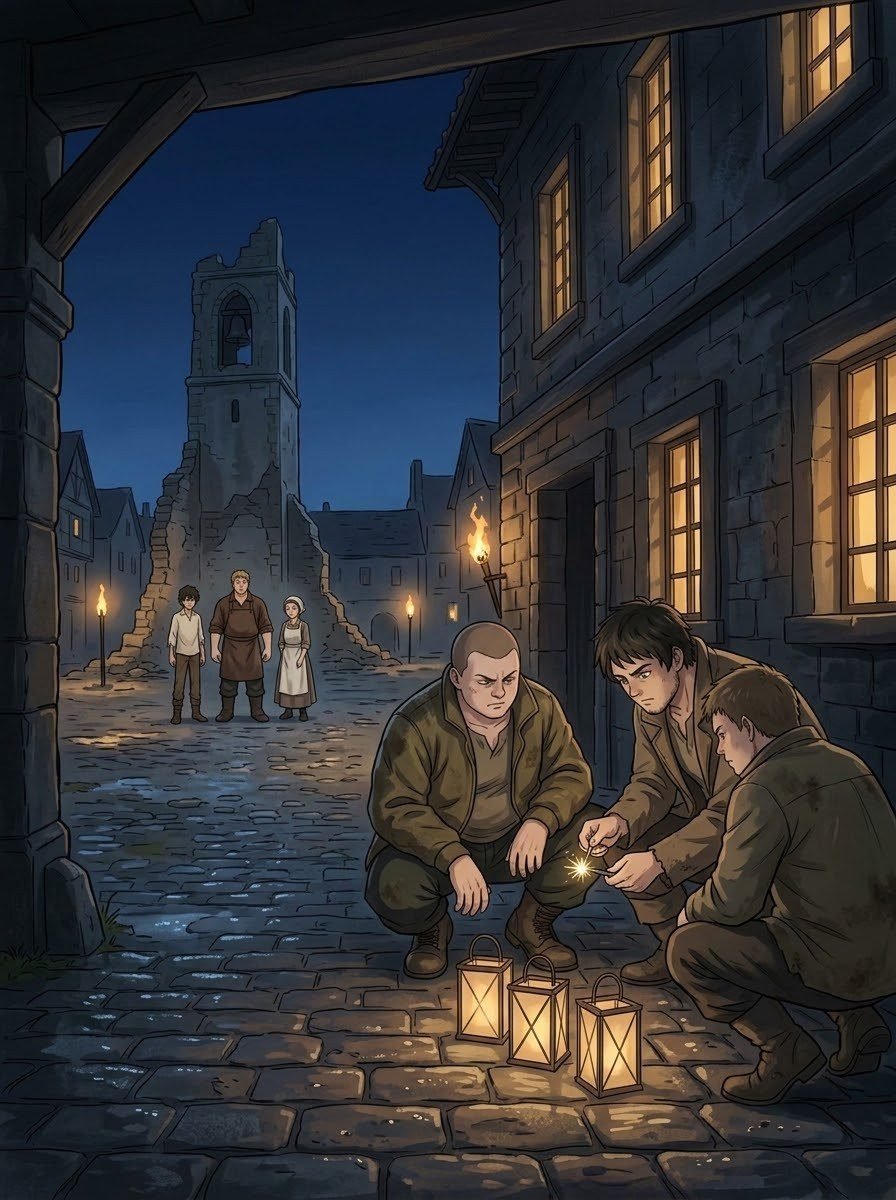
“Not lighting,” said Moss slowly.
Click. Click. Hask shook the tinder pouch and blew into it and struck again, and nothing happened, and Brint said something low and furious, and Hask threw the pouch on the cobbles.
Tilda made a small sound. Ash turned to look at her, and to his astonishment she was very nearly smiling.
“Oh, that little rat,” she said, almost fondly. “He sold them wet tinder.”