Two Grit a Loaf
Grell’s bakery sat at the west end of the market, a fat stone building with a fat stone oven and a fat stone owner, and it was the only bakery in Ketterford that bought bread from another bakery. Grell said this was because his oven could not keep up with the demand. Everybody else said it was because Mira Calder’s bread was better and Grell knew it and sold it as his own at a grit more a loaf.
Ash carried four dozen through the back door and set them on the cooling rack. Moss Barlow was there, as he always was, kneading a mound of dough the size of a sleeping dog.
Moss was two years older than Ash and built like the side of a barn. He had been Grell’s apprentice since he was ten, and in that time he had grown so large that Grell had to have the back door widened. He had enormous soft hands and an enormous soft voice and a face that looked permanently surprised to find itself on top of so much body.
“Ash,” Moss said, with real pleasure, the way he said it every morning.
“Moss.”
“You saw the notice.”
“Everyone saw the notice.”
“Four anchors.” Moss turned the dough over and leaned on it, and the whole table creaked. “You could build an oven with four anchors. A proper one. Brick, with a long throat, the kind that holds heat all night.” He said it the way some people talked about the sea. “You could bake for the whole Tallow Road with an oven like that.”
“You going to enter?”
Moss went red from the collar up. “Me? No. I’d fall off the tower. I’d break the tower.”
“You’d break the tower,” Ash agreed.
“Are you going to enter?”
Ash looked at the rack of loaves. His mother’s loaves, with her slash across the top, the one she cut with a knife so old the blade had worn into a crescent. Grell would sell them as Grell’s by noon.
“Bread Run’s today,” he said instead. “Third bell.”
Moss’s face lit. “You’re running?”
“Prize is a stone.”
“I’m running too. Master Grell says I can, if I’m back to knock down the second batch.” Moss grinned. “I’ll see you at the oven.”
Ash grinned back. Moss had run the Bread Run every month for three years. He had never once finished higher than fifth, because Moss took every corner as though he were a cart, and carts lost to boys.
The Bread Run belonged to Old Nan Tipple, and so did most of the Fourway Market, in every way except on paper.
She was the Market Queen, though she would hit you with a ladle for saying it. She had no title and no licence and no guild. What she had was forty years of standing in the same spot by the east gate, selling hot chestnuts in winter and spiced water in summer and knowing every single thing that happened within a stone’s throw of her brazier. The Market Warden licensed the stalls. Nan Tipple decided which ones lasted.
She had invented the Bread Run thirty years ago, or claimed to, and she ran it every month on the first market day. At the third bell she pulled nine fresh loaves out of her own little clay oven by the east gate, still steaming, and handed them to nine runners. Each runner had to carry their loaf across the whole market, from Nan’s oven at the east end to Grell’s doorstep at the west, through the market-day crowd, and set it down on Grell’s step whole. Not crushed. Not torn. Crust unbroken. Nan’s grandson, a solemn boy named Bertie, waited at the finish with a lantern and inspected every loaf like a Keeper.
The first whole loaf won a stone.
Twenty grit. A week of bread for the Calders. The first of the five stones he needed.
When Ash arrived at the east gate, the other runners were already there. He counted them out of habit. Moss, enormous and cheerful, rolling his shoulders. A pair of girls from the Tallow Road who ran every month and argued with each other the whole way. A thin lad from the Mill Road named Arn who was fast on the flat and hopeless anywhere else. A grim-faced older man who had clearly been dared.
And two boys Ash had never seen at a Bread Run before, leaning against the wall with their arms folded, wearing the same mud-coloured jackets and the same expression, which was the expression of a dog that has seen another dog’s dinner.
“Mallorys,” said a voice at his elbow. “From Cobble Down. Brint and Hask. They’re here for the market day. Their uncle runs a stall.”
Ash turned. A boy of about fourteen was standing there, small and sharp-faced, with hair that looked as if it had been cut with a knife in the dark. He had a coil of twine over one shoulder and an air of having somewhere better to be.
“Quent,” said Ash. Everyone in Fourway knew Quent Hobb. Quent sold things. Some of the things belonged to him.
“Brint’s the big one. Hask’s the one who bites.” Quent shrugged. “They knock loaves. Last month in Cobble Down they knocked four. Nobody can prove anything. It’s always an accident.”
“Why are you telling me?”
“I’m not. I’m telling the air, and you’re standing in it.” Quent held out a grubby hand. “One grit for the air.”
Ash looked at him. Quent looked back with perfect calm.
Ash found a grit in his pocket and dropped it in the hand. Quent bit it, pocketed it, and melted into the crowd as if he had never been there.
At the brazier, Old Nan Tipple was rapping the door of her clay oven with a long wooden paddle. She was a small, bent woman wrapped in so many shawls she looked like a pile of laundry with a face, and she had a voice that could cut through three streets of market noise.
“RUNNERS.”
The nine of them shuffled into a rough line.
“Rules,” Nan said. “You know them. You don’t know them, you shouldn’t be here. One loaf each. My loaf, out of my oven, onto Grell’s step, whole. Bertie judges. Bertie’s word is final. Anybody argues with Bertie, argues with me.” She looked down the line with eyes like two raisins. “Anybody touches another runner’s loaf, on purpose, I’ll know. Anybody touches another runner’s loaf by accident—” her eyes stopped on the Mallory brothers and stayed there, “—I’ll know that too.”
Brint Mallory smiled at her. It was not a nice smile.
The third bell began to ring from the Keepers’ hall across the square.
Nan swung the oven door open. Heat and smell rolled out together, the smell of crust and steam and the last of the morning, and she began pulling loaves out with the paddle and dropping them into nine pairs of hands. They were hot enough to hurt. Ash’s landed in his palms like a live coal and he juggled it once, swore, and tucked it against his chest with his sleeves over his hands.
“GO,” said Nan.
Eight runners went west into the crowd.
Ash went north.
He heard someone laugh behind him, one of the Tallow girls, and then the noise of the market closed over everything. The Fourway on a market day was a living thing. Carts moving clockwise round the well. Stalls jammed so tight that their awnings overlapped. Goats, children, a man with a tray of eels, two women arguing over a chicken that was very much alive and wished to be included. The straight line from Nan’s oven to Grell’s door ran right through the thick of it, and every month the runners threw themselves into that line and fought their way across like swimmers against a current.
The straight line was the fastest way, if the market was empty. The market was never empty.
Ash had watched the Bread Run every month for six years. He had run it four times and lost four times. And every time, he had noticed the same thing: the runners who won were not the fastest. They were the ones who found the emptiest ground.
And the emptiest ground in all of Ketterford, on a market day, was the sky.
He ducked down the north side of the square, along the edge where the Quarry Road came in, where the crowd was thinner because the carts came through fast and people kept out of their way. Fifty strides. Sixty. The alley mouth by Gant’s cooperage opened on his left and he swung into it, and there it was, exactly where it had been every morning for six years: Gant’s rain barrel, full to the brim, squatting under the low eave of the cooperage roof.
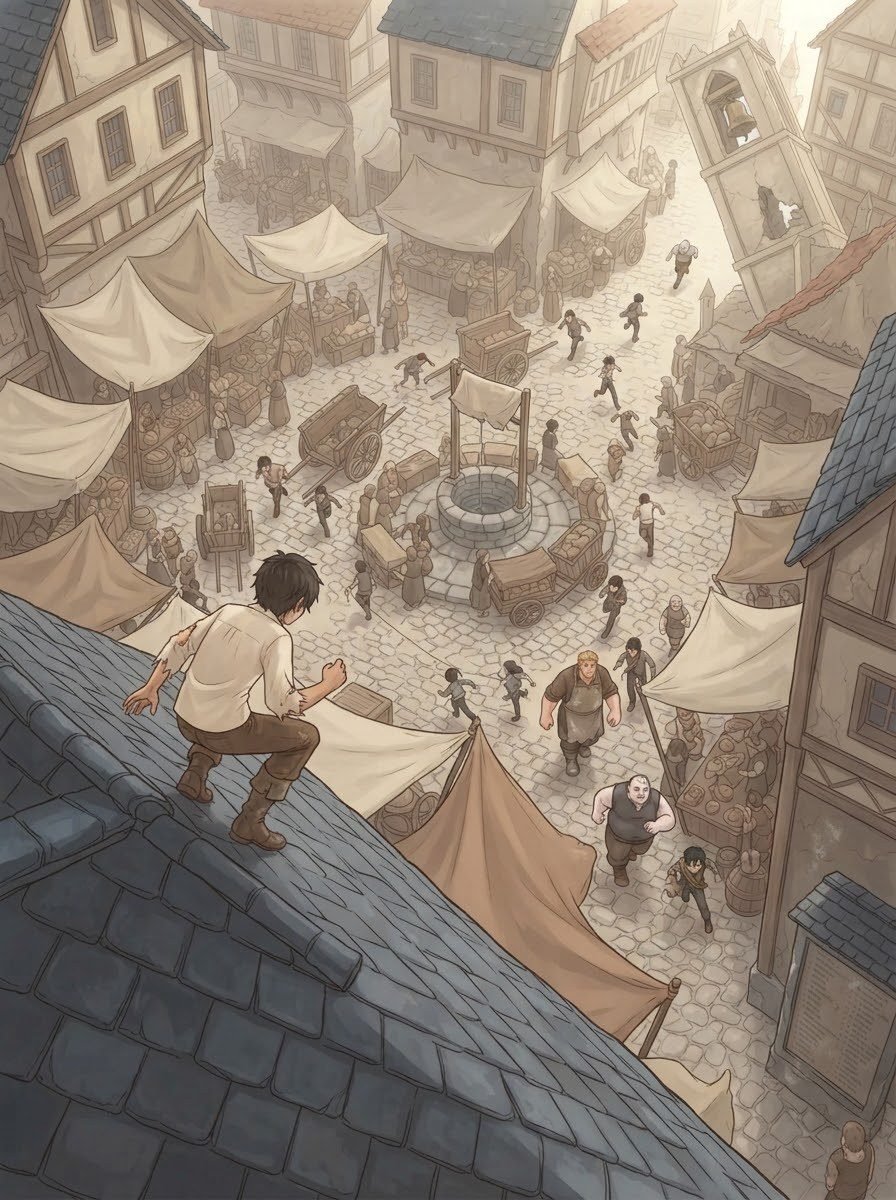
He went up the barrel without stopping. One foot on the rim, which held. A hand on the gutter, which creaked but held. His other arm clamped the loaf to his ribs. He got a knee onto the slates and then he was up, crouched on Gant’s roof with the whole Fourway Market spread out below him like a dropped quilt.
From up here he could see all of it. The well, and the carts circling it. The bell tower in its corner. The Tournament board under its slate cap. And the runners, little bobbing heads in the crowd, already strung out: Arn the Mill Road boy in front, wriggling between two carts; Moss behind him, simply walking through people, apologising to each one; the Tallow girls together, shrieking. And the Mallory brothers, running side by side, and as Ash watched, Brint put out an elbow, quite casually, and one of the Tallow girls lost her loaf into a puddle.
Accident, Ash thought. Right.
He turned away and ran.
Tallow Row was a single long terrace that ran along the north and west sides of the square, two storeys of chandlers and laundries joined roof to roof, and the laundry women had been laying planks between the gaps for longer than Ash had been alive. On washing days the rooftops of Tallow Row were a second street, strung with lines of wet sheets, and the women walked it with baskets on their hips as easily as walking a kitchen floor.
Ash had walked it a hundred times, carrying bread to the laundries. He knew every plank.
He ran along the ridge of Gant’s roof, dropped onto the flat leads of the candle-maker’s, ducked under a line of dripping shirts and took the first plank at a run. It bounced. He kept going. The second plank, longer, between the dyer’s and the widow Stott’s; the third, short and solid. Below him the market roared and steamed, and nobody looked up, because nobody in a crowd ever looks up. He was running in an empty street in the middle of a full town, and it was the best feeling he had ever had in his life.
The loaf was hot against his chest. He could feel his heart beating into it.
The corner. Tallow Row turned the corner at the northwest of the square, and here the gap between the last laundry and Pell’s cloth house was the widest on the whole Row: a long stride and a half, over a drop of two storeys into the alley where Pell kept his bolts of cloth. The laundry women had a long plank for it, the longest they had, a heavy grey board they called the Bridge.
Ash came round the chimney at full speed, already reaching with his foot for the Bridge.
The Bridge was not there.
He saw it all in one look. The empty gap. The alley floor, far down, cobbled and wet. And on Pell’s roof across the way, propped against a chimney, the long grey plank, lifted and put away by someone who had needed it this morning for something else.
He could not stop. He was running too fast to stop and the edge was right there.
So he did not stop.
He jumped.
Not across. He knew in the half-breath before his foot left the roof that he would never make the far side, not with a loaf in one arm and no run left. So he jumped out and sideways, toward the square, toward the only soft thing he could see: the green-and-white awning over the front of Pell’s cloth stall, sagging on its left side where the cracked pole had been tied and tied again all summer.
For a moment there was nothing under him at all.
Then canvas. He hit the awning on his back, loaf clutched to his chest with both arms, and the cracked pole did exactly what a cracked pole does when a boy lands on it. It folded. The whole left side of the awning dropped like a sling, and Ash dropped with it, sliding down the canvas, slower and slower, until he came to rest on a table piled high with bolts of Weirlands linen with a soft and dignified whumph.
He lay there a moment, looking up at the sky.
Then Pell’s face appeared over him, purple, with its mouth open.
“Sorry,” Ash said. “Your pole’s cracked.”
“I know my pole’s cracked!”
“You should fix it.”
He rolled off the table before Pell could find words, checked the loaf, which was whole, gloriously whole, its crust shining, and ran.
He was at the northwest corner of the square. Grell’s door was at the west end, sixty strides away, straight down the edge of the market past the Tournament board. And coming out of the crowd from his left, red-faced, sweating, both of them still holding their loaves, were the Mallory brothers.
They saw him. He saw them see him. Hask’s mouth fell open.
Then Brint’s face closed like a fist and the two of them angled across toward him, not toward Grell’s door, toward him.
Ash ran. He ran the way his father drove the ore wagons downhill, not straight but holding a line, and he held his loaf on the side away from them. Forty strides. Thirty. Hask was nearer, small and quick, and Hask’s free hand came out toward the loaf as if by accident, the way you might reach for a rail. Ash turned his shoulder into it. Hask’s fingers caught his sleeve instead and tore it from the cuff to the elbow.
Twenty strides.
Brint came in from behind. Ash felt him coming more than saw him, a bulk and a breath, and he knew what was going to happen: the stumble, the shove, the loaf in the gutter, and nobody would see anything but two boys colliding in a race.
And then Moss came out of the crowd.
He was not trying to block anybody. He was simply running the way Moss ran, which was in a straight line, through whatever was in front of him, apologising. What was in front of him was Brint Mallory. There was a noise like a sack of grain hitting a wall, and Brint went sideways into the Tournament board’s little slate roof and sat down underneath it, hard, his loaf flattened under him.
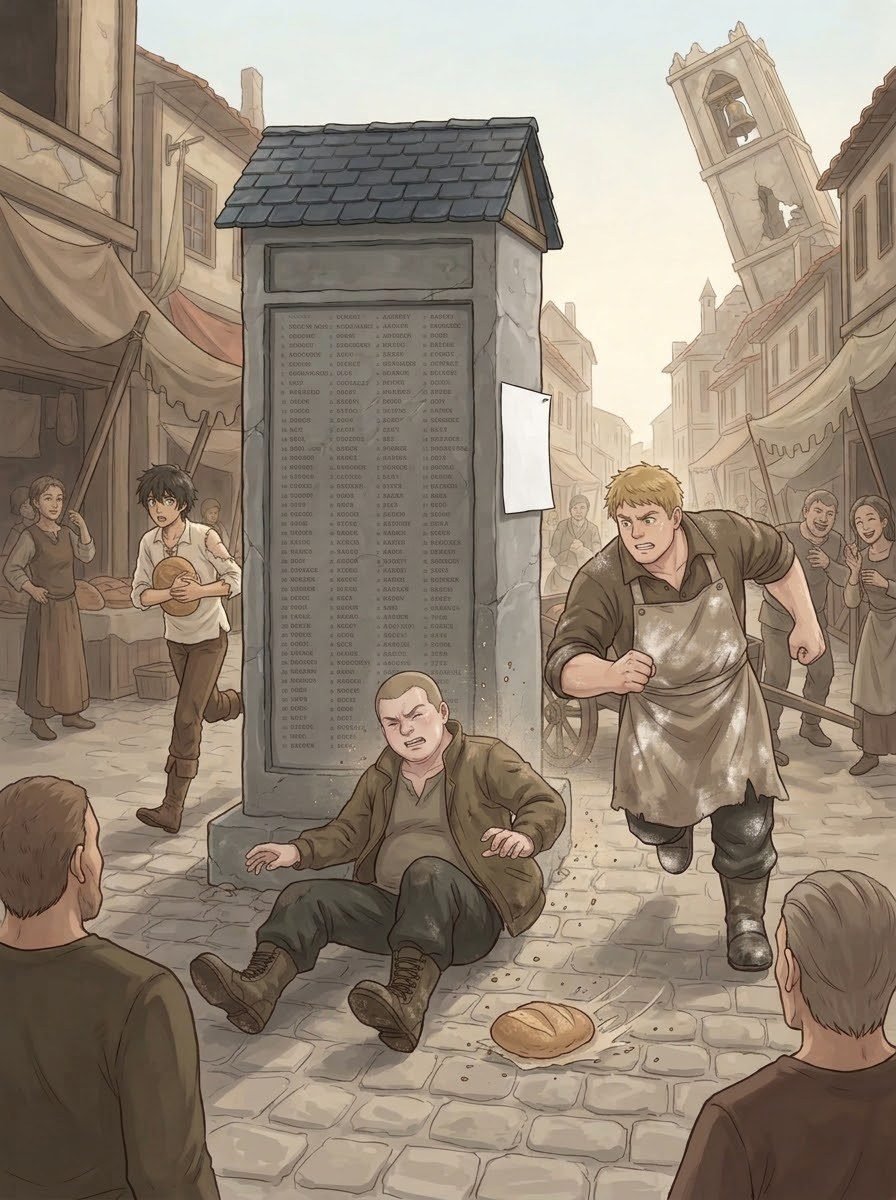
“Oh!” said Moss. “Oh no. Sorry. Sorry!”
Ash did not look back. Ten strides. Five. Grell’s step was there, worn smooth in the middle, and Bertie Tipple was standing by it with his lantern held up like a Keeper at a finish line, and Ash went down on one knee and laid his loaf on the step as gently as if it were a sleeping child.
Bertie bent and looked at it for a long time. He turned it over. He ran a thumb along the slash. He looked at the underside. He sniffed it, for some reason.
“Whole,” he announced.
Ash sat down on the cobbles and breathed.
Moss arrived next, still apologising to people in his wake, and set his loaf down beside Ash’s. Whole too. Second. It was the best Moss had ever done and he stared at his loaf as if it had performed a miracle on its own.
The Mallorys did not finish. Hask had dropped his loaf somewhere in the scramble, and Brint’s was a pancake. Brint stood up from under the board’s roof with a face like old milk, and stared at Ash across the square, and said nothing at all.