Carry Line
They went out of the north gate in a long uneven string, sixteen pairs and sixteen stones, and the crowd ran alongside them down the Quarry Road shouting, and within two hundred strides the string had broken into knots.
Aric Vell and Arn went out in front and stayed there. They did not run. They walked very fast, Arn at the front, Aric at the back, and their stretcher hardly moved between them, as if it were floating. Behind them came Gerrod and the Kite boy, steady and heavy, and then a muddle of pairs jostling for the road, and in the middle of the muddle, the Mallorys, shoulder to shoulder, using their elbows on anyone who came too close in a way that was very nearly touching and never quite.
They did not speak. They had learned that on the third morning of training: talking broke the step. Ash looked at the road a stride ahead and nothing else. He felt Moss behind him through the poles, the way you feel a horse through the reins, every shift of weight, every breath. Left, right. Left, right. On the downhill Ash leaned back and took more of the weight, as they had practised. The stone was heavy, heavier than the gravel sack, and dead, the way stone is dead. It did not shift like gravel. It just pulled down on the poles, steadily, as if it wanted very much to be back in the ground it had come out of.
They passed a pair from Tallow Cross who had stopped to argue. They passed Neve Pask and her cousin, who were walking out of step and swinging their stretcher like a hammock. Halfway down the hill they were ninth. At the bottom of the hill, where the road flattened out toward the river, they were seventh.
Somewhere on that long downhill Ash stopped hearing the crowd.
His father had a way of walking behind a loaded cart, one hand on the tail rope, that Ash had watched all his life without once thinking about it. A short step, then a long step, never both together, and the rope never slack and never tight. A load does not like to be hurried and it does not like to be coaxed. It likes to be accompanied. Ash found that he was walking like that now, and that the stretcher on the other side of the poles, which ought to have been the enemy, had begun to feel like something he was walking beside rather than something he was carrying.
He thought about the stone. Grey quarry stone from Pitch End, cut out of the face by someone, squared by someone else, strapped to a canvas frame so that thirty-two strangers could carry it down a road and up again for no better reason than to show they could. The thought made him want to laugh. His father had hauled stone like this for twenty years, and been paid in honest grit for it, and nobody had ever stood on a step and read out the rules.
He did not laugh. Laughing broke the step.
The ford at Ketter’s Ford was the reason the town was there at all. The river ran wide and shallow over a bed of flat grey stones, knee-deep at the edges and thigh-deep in the middle, cold even in summer, and fast. The Quarry Road went straight into it on one bank and straight out on the other. Carts had been crossing there for longer than the town had existed. On the near bank, in the shade of a willow, the menders had set up a table: Corva Lind in her road coat, and beside her Tilda, with her arms full of splints and her face set like a trap.
She saw them coming and lifted her chin a fraction. That was all. It was enough.
Ash and Moss went into the water without slowing.
The cold hit Ash’s legs like a slap. The stones under his boots were round and slick with weed, and the current leaned against his left side, hard, a steady push like someone shouldering him in a crowd. He swung the stretcher round without a word, so that the heavy end, the end where the stone sat closest, was upstream. Behind him he felt Moss turn with him. They went in slow, sideways to the current, Ash testing each step before he gave it his weight, and the water came up to his knees, his thighs, his waist, and the stone sat steady and dry on the stretcher above it all.
In the middle of the ford, the Mallorys passed them.
They came in fast, straight across, the way you would cross a road, their stretcher swinging, the downstream brother staggering every second step, and they should have gone in. Any other pair would have gone in. But Brint Mallory was very strong and very angry, and he simply hauled the whole stretcher through the water by main force, with Hask half floating at the back, and they passed so close that their wake slapped against Ash’s chest.
Brint looked at him as he went by. Water was running off his chin. He grinned.
Ash looked at the far bank and kept walking.
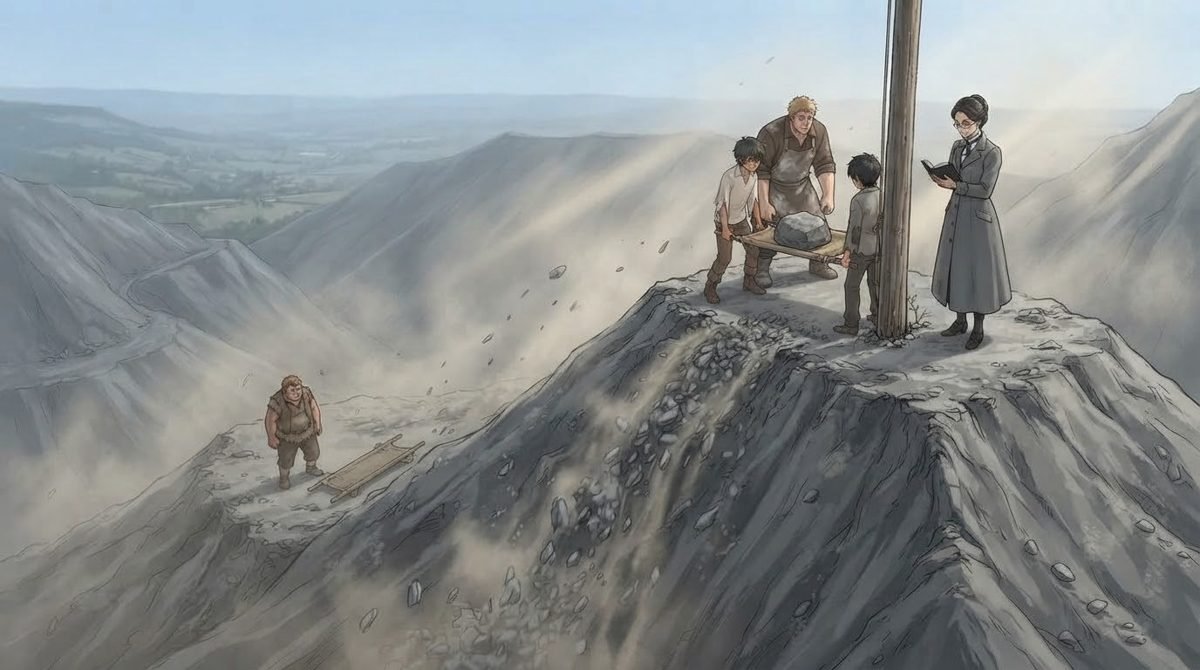
The road up from the ford to Pitch End was old and steep and made of loose grey chips that slid under every step, and the spoil heap at the top of it was worse. It was not a hill. It was a mountain of quarry waste, the broken leftovers of a hundred years of cutting, piled higher than the bell tower and grey all over like a dead fire. The Keepers had marked a path up it with little flags. At the very top, on a pole, a larger flag hung limp in the still air, and under it stood a single figure in a grey coat.
The Recorder.
Ash saw her from halfway up. She was standing a little to one side of the flagpole with the black book open in her hands, and she was not watching the pairs come round the flag. She was watching the slope. The whole slope, from top to bottom, her head turning slowly from side to side, as if she were reading it.
Moss was breathing hard behind him now. On the uphill Moss took the weight, as they had practised, and he took it without complaint, but Ash could hear what it cost him, a low grunt on every step. The spoil shifted underfoot. Every few strides a chip of stone broke loose and went skittering down the slope behind them, bouncing, clicking, like something alive.
They reached the top. Gerrod and his Kite were just going round the flag. Aric and Arn were already gone, a long way down the other side. The Mallorys were ahead of them by twenty strides.
Ash and Moss went round the flag. Ash passed within an arm’s length of the Recorder, and she did not look at him, and he did not look at her, and as he turned the stretcher on the narrow top of the heap to start down again—
The ground shrugged.
It was not much. Afterwards people would argue about whether it had happened at all. A shiver, under the feet, like the shiver of a horse’s skin when a fly lands on it. A sound, very low, more felt than heard, from somewhere deep under the spoil. Then the whole surface of the heap seemed to breathe out, and every loose chip on it moved at once.
A hiss went down the slope like rain on a roof. Small stones, thousands of them, sliding, rolling, pouring down the face of the spoil in grey ribbons. Someone below them screamed. Neve Pask’s cousin, coming up, lost his footing and sat down hard, and the end of their stretcher dropped, and the stone hit the ground with a dull crack. On the far side of the flag, the Kite boy, Tobbin, simply let go of his poles and ran.
“Hold it!” said Ash.
He did not know he was going to say it. It came out of him in his father’s voice. The ground shrugs. It’s an old man with an itch. It’ll pass. He bent his knees and braced, with the stretcher level, and behind him Moss did exactly the same thing, at the same moment, without being told, and they stood there on the top of the spoil heap, the two of them, holding a stone between them in the air while the whole hill hissed and slid away around their ankles.
It lasted perhaps ten heartbeats.
Then it stopped. The last stones clicked and rolled to the bottom and lay still. Dust hung in the air. Someone was crying. Somewhere far below, a crowd that had been shouting had gone completely silent.
Ash breathed out.
He turned his head, and the Recorder was looking at him.
She had not moved at all through the whole thing. She stood by the flagpole with her black book open and her spectacles on, and she was looking straight at Ash and Moss, at the stretcher held level between them, at their bent knees. Then her eyes went past them, down the slope, to where Tobbin Fale had stopped running and was standing halfway down the heap, ashamed, alone, his stretcher abandoned above him. And then back to Ash.
She wrote something in the black book. One line.
Then she closed it and looked away, at the slope again, as if nothing had happened at all.
“Ash,” said Moss behind him, very quietly. “Can we go now? I’d like to go now.”
They went.
The tremor had cost everyone. Three pairs had dropped their stones and had to carry them back up to the flag and start down again. Two pairs had simply walked off the course and sat down on the spoil with their heads in their hands. The Kite boy, Tobbin, had come creeping back up to his stretcher, red-faced, and Gerrod had said nothing at all to him, which was worse than shouting. They were far behind now.
Ash and Moss came down off the spoil heap in fifth place and reached the ford in fourth.
The Mallorys were in the river ahead of them, halfway across, hauling. On the far bank, under the willow, Tilda stood at the menders’ table with both hands flat on it, watching. Corva Lind was bandaging a Tallow Cross boy’s ankle. Along the bank, the crowd from the town had come down to watch the pairs come back, and they were shouting, and Ash heard his name in the shouting, Calder, Calder, the sky-road boy, and pushed it out of his head.
He swung the stretcher upstream. They went in.
The cold was worse the second time. His legs had been warm from the spoil and the river took all of that in one gulp. The current leaned on him. He leaned back. Step. Test. Step. Behind him Moss was breathing in long rough hauls, but his step did not break once. Knee-deep. Thigh-deep. The Mallorys scrambled out on the far bank and started up the Quarry Road at a stumbling run.
Waist-deep, in the very middle of the river, Ash felt the front pole move in his left hand.
Not much. A give. A softness, as if the wood had turned to green stick. Then a sound, under the noise of the water, small and sharp and dreadful: a crack, like a knuckle.
The left front pole folded.
It did not snap clean. It broke inward, halfway along, and the whole front left corner of the stretcher dropped toward the river. The canvas sagged. The stone slid. Ash felt it go, felt the whole dead weight of it lurch toward his side and toward the water, and he did the only thing he could think of: he let go of the pole and threw both arms round the stone itself, and took its weight against his chest.
It was like hugging a cart. His feet went out from under him on the weed. For one heartbeat he was going down, into the cold, with a block of quarry stone on top of him.
Then Moss was there.
Moss had let go of his own end. Ash never knew how he had crossed the length of the stretcher in that river so fast. But he was suddenly beside Ash in the water, enormous, and he got his hands under the stone from below, the way a baker lifts a full tray from a deep oven, and he simply held it up. Held it, and Ash, together. Water broke white against his chest. His face was red and his teeth were bared and he did not make a sound.
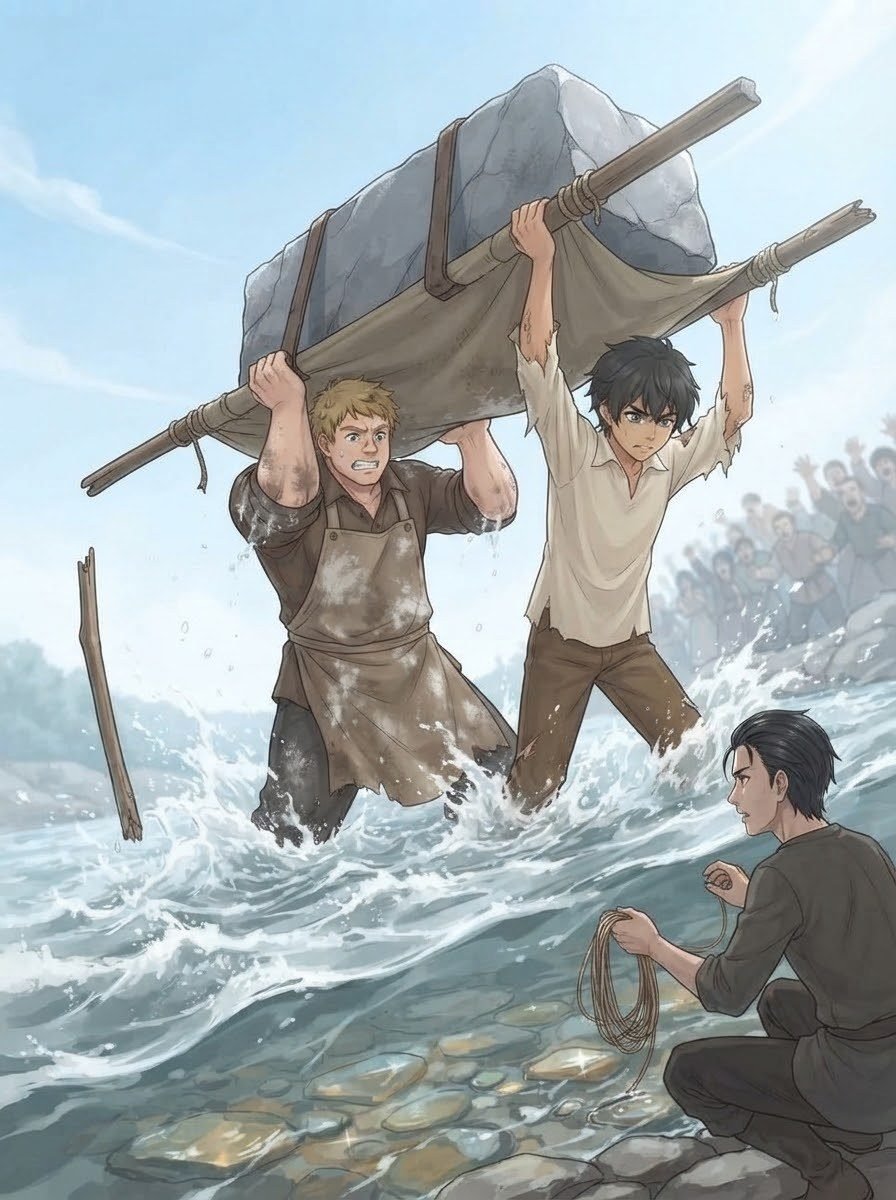
The stone had not touched the water. Not once.
On the bank, Ash heard Tilda shout something that was definitely not a mender’s word.
“Don’t put it down,” Ash gasped. “If it touches—”
“I know,” said Moss, through his teeth.
“Back to the spoil. We’d have to—”
“I know.“
They stood in the middle of the ford with the river pulling at them and the stone between them and the broken stretcher dragging in the current from its straps, and Ash looked at the bank, and at the crowd on the bank, and at a small sharp-faced figure crouched at the very edge of the water, holding up a coil of twine.
“Two grit!” Quent Hobb shouted. “Two grit for the twine! Best hemp in Ketterford!”
“Put it on my slate!” Moss bellowed, so loud that half the crowd jumped.
Quent threw. The coil landed on the stone, which was the only dry thing in the river, and Ash got one hand free and grabbed it. He did not know any proper knots. He knew the knots his father tied on ore wagons: round and round and pull and round again until it held. He bound the broken pole to the side of the whole one, in a long ugly splint, round and round, while Moss held the stone up out of the river alone and the crowd on the bank went absolutely silent.
“Done,” said Ash.
Moss lowered the stone onto the canvas. The splinted poles bent. They held.
They came out of the water on the far bank with the stretcher dripping and lopsided and the crowd going mad around them. Tilda was there, at the edge, shouting, and Ash could not hear a word she said. Somewhere off to the side he saw Gerrod Mace and Tobbin Fale coming down to the ford from the spoil, too far behind, much too far.
And as they turned up the Quarry Road, Ash looked down at the broken pole, splinted with Quent’s twine, and saw where it had broken. On the underside. Where the canvas hid it. A clean, straight, shallow line across the wood, pale and fresh, too straight for any crack.
He said nothing. He looked up the road, and walked.