Two Grit a Loaf
Every winner in Ketterford had their name cut into the same grey stone, one line a year, going back further than anyone could read. Above the newest name there was one more row, cut and smoothed and exactly the right size for a name.
It had always been empty.
On the morning the notice went up, Ash Calder’s father could not cross the yard without a crutch, and Ash had already decided he would not look at the bell tower.
The oven woke before anyone in the Calder house did, and it woke angry.
Ash heard it through the floorboards: the iron door complaining on its hinge, the scrape of the ash rake, his mother’s low voice telling the fire exactly what she thought of it. Mira Calder spoke to her oven the way other women spoke to husbands who came home late. Firmly, and with no expectation of an apology.
He lay still for one more breath. The ceiling above his bed sloped so low he could touch it without straightening his arm, and someone, years ago, had carved a row of little notches into the beam there. Ash had added to them every winter until he was twelve and then stopped, embarrassed. Pim had taken over since. The notches were Pim’s height now, not his. The newest one was barely a finger above the last.
“You’re awake,” said Pim from the other bed, which was not a bed so much as a sack of straw with ambitions.
“I’m not.”
“You are. You breathe different when you’re awake. You breathe like you’re thinking.”
“Go back to sleep.”
“Can’t.” A rustle. A small chalk-white hand appeared over the edge of the straw and held something up in the grey light. “Look.”
It was a nub of board chalk, the soft yellow kind the Market Warden’s boys used to write the day’s prices on the slate by the well. Pim collected them the way other boys collected beetles. He had forty-one. He would tell you the number if you asked, and also if you didn’t.
“Where’d you get that one?”
“Under the Tournament board.” Pim’s voice dropped to a whisper, as if the board might hear him from across the town. “They were cleaning it. For the notice. It’s going up today, Ash. Today. Nan Tipple said.”
Ash did not answer. He looked at the notches on the beam instead. One for every winter. A whole life in little cuts.
“Ash.”
“I heard you.”
“Are you going to—”
Downstairs, the oven door banged shut, and their mother’s voice came up the ladder like a thrown pan. “If the two of you are going to whisper about the Tournament, you can whisper about it while you carry flour.”
Pim pulled the blanket over his head. Ash rolled out of bed, hit his head on the beam, and went down the ladder rubbing it.
The Calder house stood at the low end of Oven Row, where Ketterford’s bakers had lived for as long as there had been bread worth selling. It was a narrow building, two rooms stacked on each other like loaves in a basket, with the oven taking up most of the bottom one and the family fitting itself around the rest. The front shutter opened straight onto the Row, and on market days the shutter became a counter and the counter became the only thing that kept them fed.
His mother was already flouring the board. She had her sleeves rolled to the elbow and a smear of white across one cheekbone, and she did not look up when he came down.
“Twelve dozen for the stall,” she said. “Four for Grell. Two for the Kites’ hall, and they’ll want them on the slate again, so don’t let that captain talk you into anything.”
“He never pays.”
“He always pays. He just pays late.” Mira pushed a tray toward him. “Which is a kind of paying. Go.”
Ash took the tray. Through the back door he could see the yard: the woodpile, the water butt, the little bench against the wall where his father sat in the mornings now, because the mornings were when the leg was worst and he did not like anyone to watch him get up.
Hollis Calder was sitting there now, his crutch leaned against the wall beside him, peeling an onion with an old clasp knife. He had been a quarry carter for twenty years, driving ore wagons up out of the pits at Pitch End, and he still had a carter’s shoulders, wide and sloped from holding back horses on the downhill. Below the knee of his left leg, though, the shape of him had gone wrong. The bone had healed crooked two winters ago and then never quite stopped hurting, and he walked now with a swing in it, the leg coming around like a gate on a bad hinge.
“Morning,” Ash said.
His father looked up. “You hit your head.”
“The beam hit me.”
“Mm.” Hollis went back to the onion. “Beam’s been there longer than you. Show some respect.”
Ash grinned despite himself and went to load the barrow.
Two winters ago the ground at Pitch End had shrugged. That was what the quarrymen called the small quakes that came every few years: a day of loose stones and nervous horses, then nothing.
It had shrugged under the north face while Hollis’s wagon was loading. The horses bolted, and the wheel went over his leg twice, once forward and once back.
The Ketterford bone-setter had done what he could. What he could had not been enough.
Three weeks ago, a travelling mender had come through with a caravan from the Stoneward road, a lean woman with a Stitchery badge sewn to her shoulder, and Bette had paid her two stones to look at it. She had pressed her thumbs along the bone while Hollis sweated and said nothing, and then she had sat back on her heels and said it plainly, the way menders did.
The bone had set wrong. It could be broken again and set right, but not here. In Stoneward, at the Stitchery, with the proper tools and a month of rest after. It would cost three anchors.
Three anchors. The Calders earned, in a good year, a little over three anchors altogether. Bread and mending and the odd day’s carting Hollis could still manage when the leg allowed. Three anchors was a year of their lives with nothing eaten.
Nobody had said much after the mender left. Mira had gone back to the oven. Bette had gone back to her sewing. Hollis had said, “Well,” and then nothing else, and that one word had sat in the house ever since like a stone nobody would lift.
Ash had lifted it every night in his head. He had turned it over and looked at every side of it. And every side had the same thing written on it.
By the time he pushed the barrow out onto Oven Row, Ketterford was waking up around him.
It was a market town, which meant it woke loudly. Carts came in on the four roads, one of them the Stoneward Road, which ran two days west to the city where the real games were played. Where the roads crossed stood the Fourway Market: cobbles, stalls, awnings, the old well in the middle, and the broken bell tower over one corner like a tall man who had forgotten why he came into the room.
Nobody knew how old the tower was. Older than the town, people said, which was the kind of thing people said about anything with moss on it. Its bell still hung in the top, green with age, and once a year, on Stone Day, the final round of the Pass Tournament was a race to ring it.
Ash did not look at the tower. He made a point of not looking at it. He looked at the cobbles instead, and at the barrow, and at the clockwise drift of the morning carts around the well, which always went the same way because the Warden had painted an arrow on the stones sixty years ago and nobody had ever thought to argue.
He noticed things like that. He could not help it. Which carts were early, which stalls opened late, which awnings sagged and which held, where the puddles stood after rain and where they drained. Bette said he had a mind like a gutter: everything ran into it and nothing ran out.
Pell’s cloth stall had a sagging awning again. The left pole had been cracked since spring and Pell kept tying it rather than replacing it. The laundry women of Tallow Row had their planks out already, the narrow boards they laid between the rooftops so they could carry wet sheets from house to house without going down to the street. Old Gant the cooper had left a rain barrel full to the brim under his eaves, the way he did every night, because he was too lazy to drain it and too stubborn to admit it.
Ash noticed all of it, and none of it meant anything, and he pushed the barrow on.
The Tournament board stood on the west side of the square, under its own little slate roof, and there was already a crowd around it.
It was a slab of grey stone taller than a man, set into the ground like a tooth. Every year the winners of the Ketterford Pass Tournament had their names cut into it, one line a year, going back further than anyone could read. The oldest lines at the bottom were worn so smooth that rain ran over them without stopping. The newest, at the top, were sharp enough to cut a finger.
And above the newest name, the empty row.
Pim had asked about it a hundred times.
Old men said the Founders had left it for the best player Ketterford would ever make. Old women said it was for luck. The stonecutter who carved the new names every year said he had been told by his master, who had been told by his, never to touch it, and that was all he knew and would Pim please stop asking.
Today nobody was looking at the empty row. They were looking at the sheet of new paper nailed beside the board, still white, its ink still glossy.
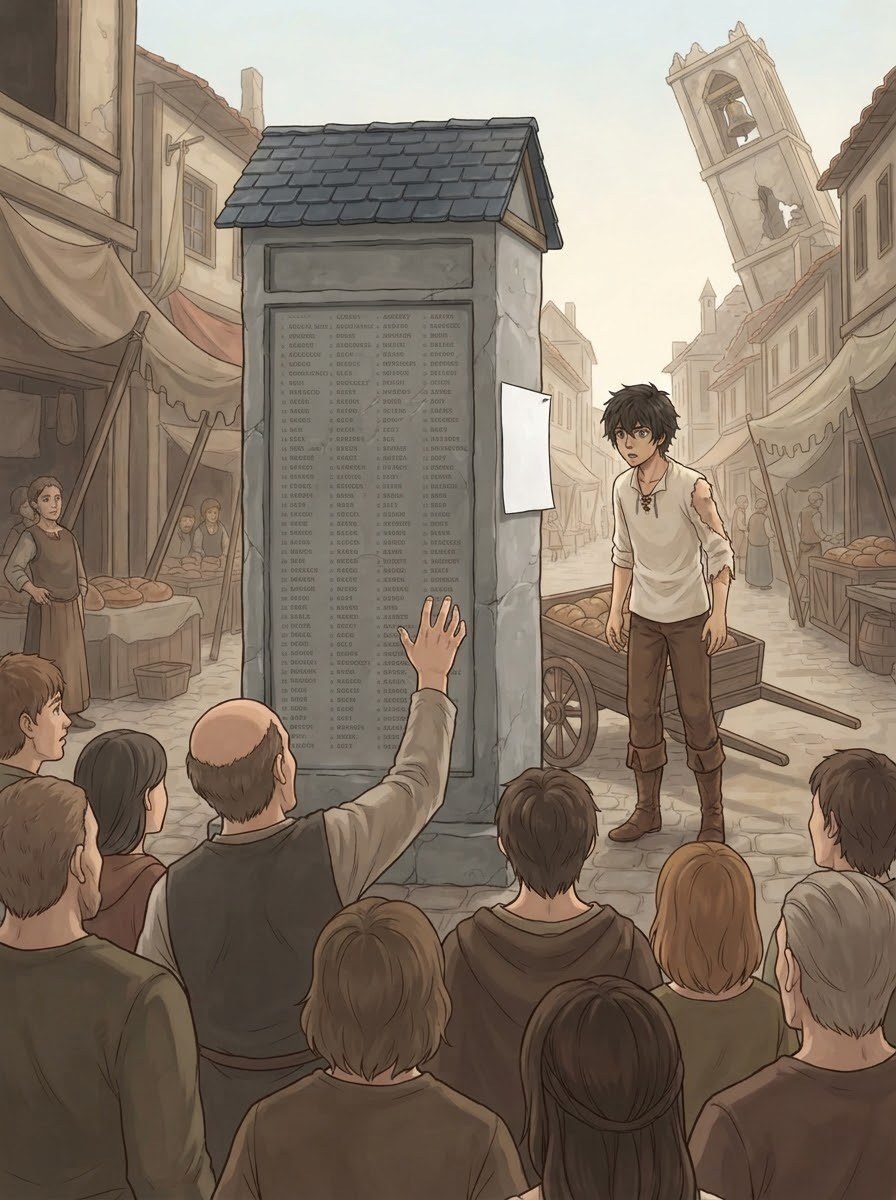
Ash stopped the barrow at the back of the crowd. He did not need to push closer. He could read it from here.
PASS TOURNAMENT OF KETTERFORD. STONE DAY, THE LAST DAY OF THIS MONTH. OPEN TO ALL OF SIXTEEN YEARS AND OVER. ENTRY FIVE STONES, PAID AT THE KEEPERS’ TABLE BY THE EVE. TO THE WINNER: THE PASS TO STONEWARD, AND A PURSE OF FOUR ANCHORS FROM THE TOWN. BY ORDER OF THE KEEPERS. GATEKEEPER ELAM FISK.
Four anchors.
Ash read it twice, slowly, to make sure the ink had not lied to him the first time.
Four anchors. Three for the Stitchery. One left over for the month of rest after, for bread and wood and Bette’s thread and Pim’s boots, which had a hole in the left toe that Pim pretended not to have noticed.
Four anchors, and the pass besides.
Someone jostled the barrow. Ash steadied it without looking. In the front of the crowd, a man with a merchant’s coat was reading the notice aloud for those who couldn’t, slowly and with great importance, as though he had written it himself. Somebody laughed at the line about sixteen years. Somebody else said the Kites would win it again, they always did, and somebody else said the Kites hadn’t won it in six years, not since Gerrod Mace, and the first man said that was what he meant.
Ash was sixteen. He had been sixteen for nineteen days.
He picked up the barrow handles and went to deliver the bread, and he did not look at the bell tower the whole way.
THE SILENT BOARD is also published on Royal Road by its author, ahmyabbasi18.