Party of Strangers
It took Ash less than a hundred heartbeats to see it, and when he saw it he could not believe how simple it was.
The Kings had three lanterns and no fire. Ash’s party had two lanterns and no fire. Nobody could win unless somebody found fire and somebody found all five. And the rules said a runner could only be tagged from behind, open hand on the shoulder.
From behind.
“Moss,” he said. “How hot does Grell keep the night oven?”
Moss blinked. “Hot as anything. The second batch goes in at the midnight bell.”
“Can you carry fire from it? Without burning yourself again?”
“There’s a coal pot by the oven door. Clay. With a lid.” Moss’s face was slowly lighting up. “Grell uses it to start the stall braziers in the morning. You fill it with coals and you can carry it across the whole market. I do it every day.”
“Go and get it. Bring it here. Walk, don’t run, and keep the lantern from the ash pit in your other hand where they can see it.”
Moss went.
Ash turned to Tilda. “When Moss comes back, he’s going to walk straight across the square toward the Weigh House. With fire. And two lanterns.”
Tilda looked at him as if he had gone mad. “They’ll tag him the second he gets there.”
“They can only tag him from behind,” said Ash. “So he walks up to the Weigh House wall, and he turns round, and he puts his back against it.”
Tilda opened her mouth. She closed it again.
“He stands in front,” said Ash. “That’s his job. They’ll come round him like dogs round a bear. All four of them, trying to get behind him, and they can’t, because there’s a wall behind him. And while they’re all looking at Moss, they’ll put their lanterns down, or hold them loose, and they won’t be looking at the roof.”
“The roof,” said Tilda.
“The Weigh House roof joins Tallow Row at the corner. I’ve walked it.” Ash was already moving. “You come round the other side, low, along the stalls. When I drop, I’ll tag the one with the most lanterns. You tag the next. Then we run for the step. Moss runs too. Nobody can tag us on the step.”
“And the fire?”
“Moss brings the fire to the step.”
Tilda stood very still. Then she pulled her mender’s cap tight over her ears, and her mouth went into its thinnest line yet, which Ash would learn meant she was happy.
“If he gets hurt,” she said, “I’m stitching you shut.”
It did not go the way he planned. Nothing ever did, he would learn. But it went close enough.
Moss came back across the square with the clay coal pot held out in front of him in both hands, glowing faintly at its lid, the ash-pit lantern swinging from one big finger, and the whole Fourway turned to watch him. He walked straight for the Weigh House as if he were delivering bread. The Kings saw the glow and came off the wall to meet him, all four, and Brint was grinning, and then Moss reached the wall and turned round and put his back flat against it, and the grin went off Brint’s face like a candle being pinched.
They circled him. Of course they did. Hask darted left, and Moss shuffled left, wall at his back. One of the heavy cousins tried right, and Moss shuffled right, and said, “Sorry,” and the cousin bounced off his shoulder. The Kites’ judge on that corner, a lanky boy in blue, stepped closer, hands on his knees, watching for a punch.
The Kings’ three lanterns sat in a row on the cobbles behind them. Forgotten. Except one, which Brint had picked up and was holding loosely by its ring, out at his side, as though it were a weapon.
Ash dropped off the Weigh House roof.
He landed behind Hask, which was not the plan, because Hask had moved. He slapped Hask’s shoulder with an open hand and shouted “TAG,” and the judge’s head snapped round, and Hask spun with his mouth open and Ash said “One lantern,” and Hask, with his face working, pointed at the row on the ground. Ash snatched one up.
Tilda came out of the dark beside the knife-grinder’s barrow, low and fast, and slapped the bigger cousin’s shoulder so hard he yelped. “TAG.” She snatched the second.
Which left the one in Brint’s hand.
Brint understood all at once, Ash saw it go across his face, and he swung round toward Ash with the lantern held high out of reach and his other hand coming up in a fist, Bare rule or no, and the judge was shouting something—
And Moss stepped off the wall. Just one step. Into Brint, from the side, the way he had at the Bread Run, not hard, the way a door closes in a draught. Brint staggered. His hand opened. The lantern dropped.
Ash caught it before it hit the stones.
Behind him, very clearly, the bell in the Keepers’ hall began to ring midnight.
“RUN!“
They ran. The three of them, and Moss behind with the coal pot, lurching, both arms clamped round it. Forty strides to the tower step. The bell rang a second time. Thirty strides. Hask was coming after them, small and fast, and Ash heard him close behind, his breath, his hand reaching for a shoulder—and then they were on the step, all three, and the Kites’ head judge on the step put out an arm like a gate and said “Safe,” and Hask skidded to a stop at the bottom with his hand still out.
Five lanterns on the step. The bell rang a third time.
“Moss!”
Moss came up the step with the coal pot, and his boot caught the edge of the stone, the old worn edge of a step that had been climbed by a thousand players, and he went down on one knee. The pot flew out of his arms. It hit the step and cracked in two and the coals went everywhere, bright red, bouncing down the stones and hissing out in the dew on the cobbles below.
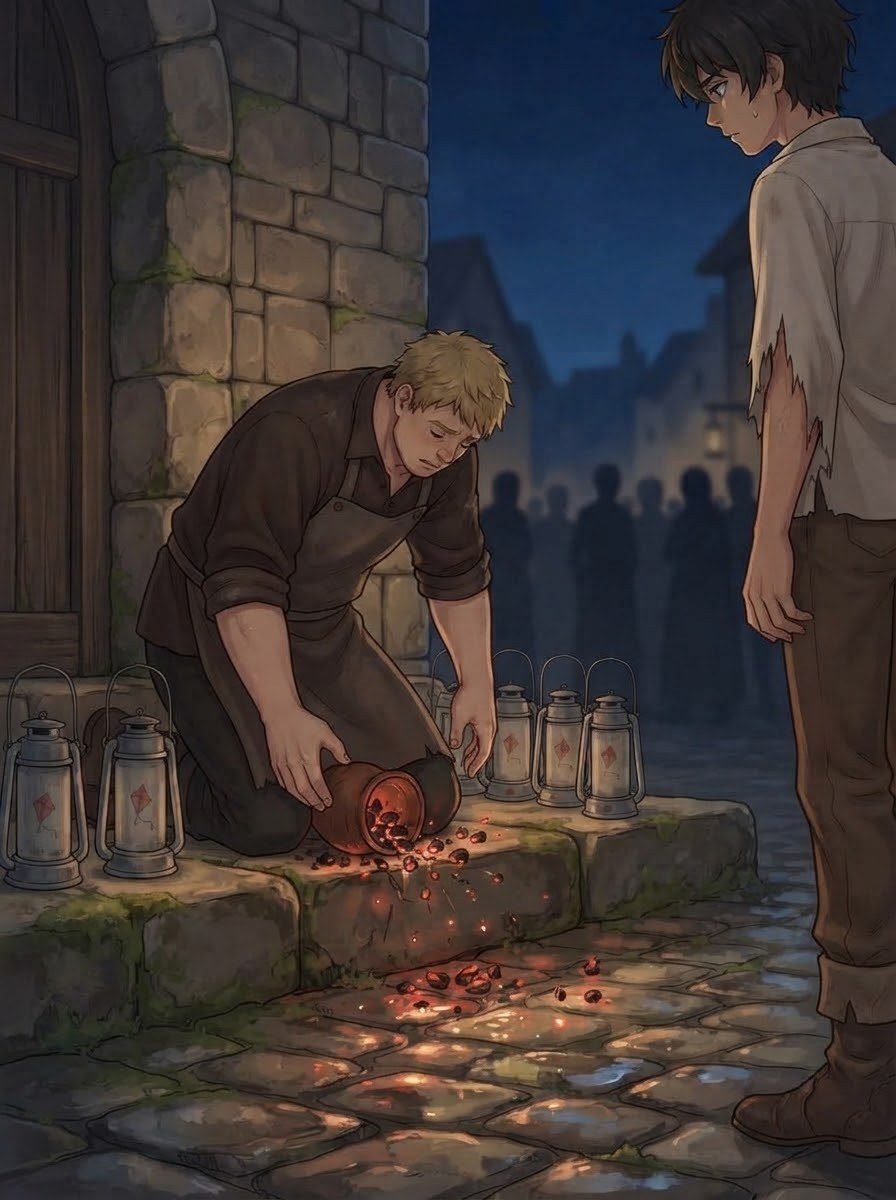
Fourth stroke.
Ash stared at the dying coals. At the five cold lanterns. He could not think of anything. There was nothing to think of. Fifth stroke. All around the square, the crowd had gone silent to listen to the bell.
Sixth stroke. Seventh.
Someone dropped onto the tower step beside him from somewhere above, from the first ledge of the tower itself, where no one had looked, and crouched over the lanterns, and there was the snap of steel on flint, once, and a small bright bloom of fire in a twist of dry tinder, the driest tinder Ash had ever seen.
Eighth stroke. Quent lit the first lantern. Ninth. The second. His hands moved so fast Ash could not follow them. Tenth. Third. Eleventh. Fourth.
Twelfth.
The fifth wick caught as the last stroke of midnight hung over the Fourway and slowly, slowly, died away.
Five lanterns burned on the step of the old bell tower.
For a heartbeat nobody in the square made a sound. Then the crowd exploded.
“I sold them the answers,” Quent said afterwards, sitting on the step with his chin in his hands while the crowd swirled around them and Tilda wrapped Moss’s knee. “For a stone. A whole one. Paid up front. You were only offering half, and only if we won.” He shrugged. “A stone in the hand.”
“You sold us,” said Ash.
“I sold them answers. I never said I’d sell them my good tinder. I sold them the stuff I keep for people I don’t like.” Quent looked at him sideways. “And then I went up the tower to the first ledge and waited to see what you’d do. I wanted to see if you were any good.” He considered. “You were all right.”
“If Moss hadn’t fallen, we wouldn’t have needed you.”
“But he did,” said Quent simply. “People always fall. That’s why you need Support.” He held out his hand. “Half a stone.”
Tilda looked up from Moss’s knee. “You’re not getting a grit.”
Ash looked at the hand. He thought about it for a long time. Then he said, “When you’ve earned it,” and Quent, after a moment, grinned and put the hand away, as if that were an answer he could respect.
Gerrod Mace paid them himself, at the Kites’ table, out of a heavy blue purse, in front of everyone. Twenty stones, five for each, counted out in neat stacks. The crowd cheered every stack. Moss stared at his five stones as though they might hatch. Tilda counted hers twice and then put them away very fast, before anyone could see her hands shaking. Quent, who could not enter, took his stack and sold his place in the Tournament book to nobody, because there was nobody to sell it to, and then sold the five stones back to Gerrod on the spot for four and a half in ready coin, which Gerrod paid, laughing.
Ash’s stones went into the Kites’ book under his name, to be paid at the Keepers’ table on the eve. He would never touch them. He did not care. He stood by the table with the noise of the square around him and his ears still ringing with the bell, and he thought: I’m in.
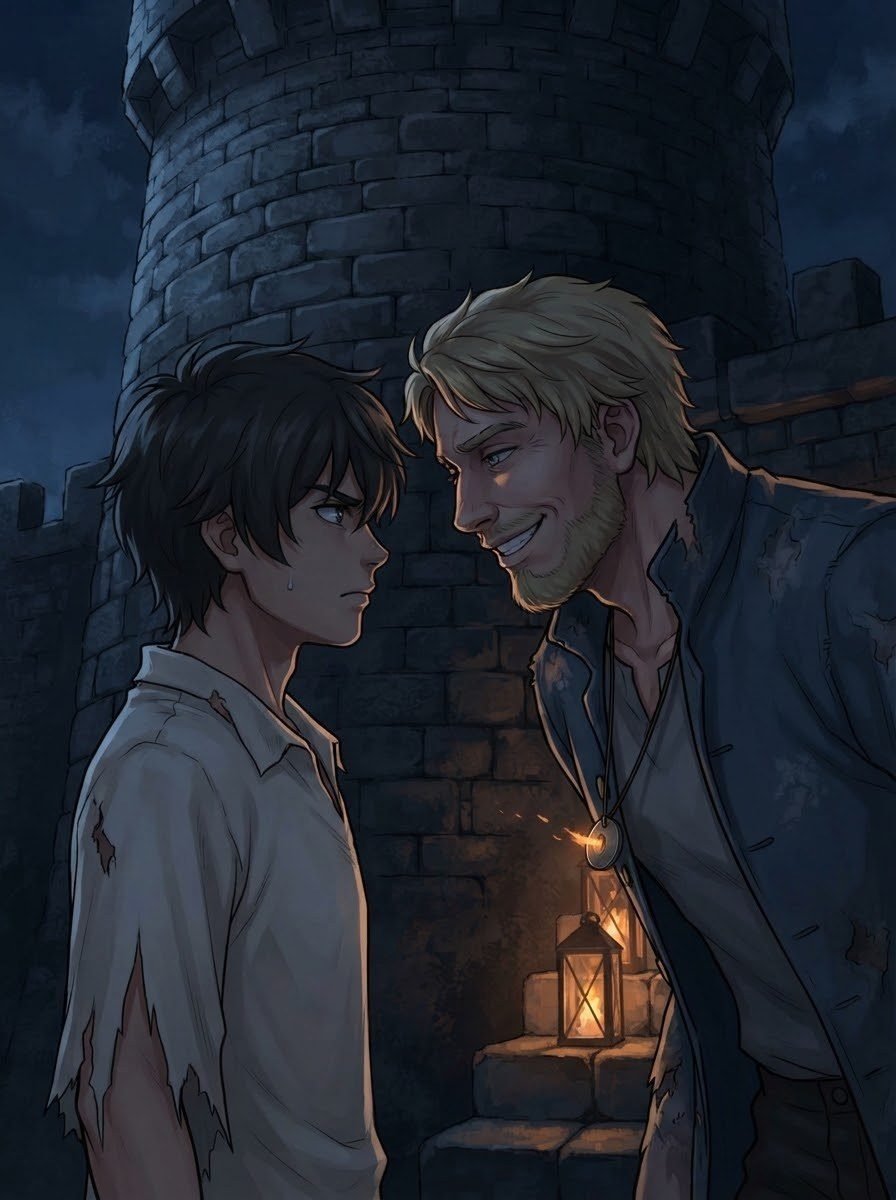
When the crowd began to thin, Gerrod Mace put a heavy hand on his shoulder and steered him, gently, round the side of the Kites’ table and into the shadow of the tower, where nobody else could hear.
Up close, the captain smelled of ale and lamp oil. The pass on its cord around his neck caught the light of the burning lanterns on the step. Ash could see the design on it now: a stone tower, and above it, very small, a row of stars.
“Nice work,” said Gerrod. “Really. Six years I’ve run that Hunt. Nobody’s ever used a wall before.”
“Thank you.”
“Here’s the thing, though.” Gerrod’s voice did not change. It stayed warm and easy and friendly, and his hand stayed on Ash’s shoulder. “The Kites paid your entry. So you’re a Kite now. For the Tournament, at least. You’ll run in blue, with our name on you. That’s how it works.”
“All right.”
“And Kites run for the Kites.” The hand squeezed, just a little. “If you get as far as the Climb, which you might, you’ve got good legs, you’ll do what the Kites need. When I tell you to go up, you go up. And if I tell you to come down…” He smiled. It was a lovely smile, and nothing in it reached his eyes. “You’ll lose when I tell you to, Ash Calder. Or the Kites will want their five stones back. With interest. And your father can’t afford the interest. Can he?”
He patted Ash’s shoulder twice, like a man settling a horse, and walked back into the light.