The Stalls Maze
“He said that?” said Bette. “You’ll lose when I tell you to?“
“With his hand on my shoulder.”
They were on the roof. Not Tallow Row: their own roof, the low flat stretch over the back room of the Calder house, where Mira dried herbs in summer and where Bette had come, as a little girl, to cry about things she did not want anyone to see her cry about. It was the only place in the house nobody could hear. It was two nights after the Lantern Hunt. Below them, Ketterford was dark except for the night oven glowing at the end of Oven Row, and the lamps in the Weigh House, where the Kites were still drinking.
Bette sat with her knees drawn up and her shawl round them and thought about it for a long time.
“He can’t make you,” she said at last.
“He can ask for the five stones back. With interest.”
“He can ask.” Bette’s voice had gone hard. “The Kites aren’t the Keepers. They aren’t a lender. They’re a club of men who drink in the Weigh House. If Gerrod Mace wants to go to the Warden and say this boy didn’t lose when I told him to, let him. Let him say it out loud, in front of the whole town, and see how that sounds.”
Ash did not say anything. He was thinking about the Warden’s hand, held out palm up, and a stone dropping into it. He was thinking about how a thing could be crooked in front of a hundred people and still go the crooked way.
“Why does he even care?” Bette said. “He’s a Pocketer. He’s not going anywhere. Why does it matter to him who rings the bell?”
“I don’t know.”
“Then that’s the first thing to find out.” She stood up and shook out her shawl. “Meanwhile you’re going to win the first two rounds, because you can’t lose a Climb you’re not in. And you can worry about Gerrod Mace when you’re standing at the bottom of that tower. Not before.”
She went to the trapdoor, then stopped.
“Ash,” she said, not turning round. “If he asks you to lose. In the end. And it’s the stones or the leg.”
He waited.
“I’d rather owe the Kites forever,” said Bette, and climbed down.
He trained with Moss every morning for the next ten days.
They borrowed a stretcher from the Stitch Room, which Tilda arranged by a method she refused to explain, and they loaded it with a sack of quarry gravel that Moss guessed at sixty pounds and that Ash, after carrying it up Tanner’s Hill twice, privately believed was twice that. They carried it at dawn, before the oven was hot, up the Quarry Road and down again, along the ford path to the river and back. People stared. Children followed them. On the third morning Pim came too and walked alongside with a stick, calling the step, left, right, left, right, until Moss said very politely that if Pim did not stop he would put him on the stretcher instead of the gravel, and Pim, delighted, demanded to be put on the stretcher.
The stretcher had a brown stain on one pole in the shape of a country nobody had heard of, and by the second morning Moss had named it the Duchess and would hear nothing said against her. She had a squeak in the left strap that told you, a hundred strides in advance, exactly when you were about to go downhill. “She’s complaining,” Moss would say, with deep affection. “She hates the hill.” Ash, who had never in his life named a thing that was not a dog, found that he had begun to say “mind the Duchess” without noticing, and that it made the gravel weigh a little less.
They found out things. That Moss was stronger on the uphill and Ash steadier on the down. That if they both looked at their feet, they went faster; if either looked up, they broke step and the stretcher swung. That the ford was the worst place, because the stones were slick and the current pushed against the downstream leg, and the only way across without dropping the load was to go slow, with the heavier end upstream, and not talk.
And they found out that they walked exactly in step. Ash had said it to Moss in Grell’s back room to persuade him, and he had half believed it. Now he knew. Something in the length of their legs and the rhythm they had both picked up on Oven Row, years of carrying trays on cobbles, meant that once they started they did not have to think about it. They just went. Like two halves of one cart.
On the ninth morning they carried the gravel to the ford and back and neither of them said a word the whole way, and when they put the stretcher down outside the Stitch Room, Moss stood looking at it with his hands on his hips and said, “Huh,” in a voice of great surprise, and Ash knew exactly what he meant.
On the last night before the Keepers’ table went up, Ash came down the ladder to find his father sitting at the kitchen table with the lamp pulled close and nothing at all in his hands.
Hollis Calder never sat with nothing in his hands. Ash stopped on the third rung, which creaked, and neither of them pretended it hadn’t.
“Sit,” said his father.
Ash sat. The table was scrubbed pale and smelled of flour and old smoke. Mira had gone to bed an hour ago with the door pushed to, which in that house was a kind of speech.
“I’m not going to say it again,” said Hollis. “What I said. I’ll say something else instead.” He looked at the lamp rather than at Ash. “Twenty years on the quarry road, you learn one thing the carters’ guild won’t put on a paper. A road remembers. Every cart that ever went over it leaves a mark, and the next cart follows the mark, because it’s the easy way, and the one after that follows the same. After a hundred years the road isn’t what the Warden’s men say it is. It’s what the carts did to it.” He rubbed his bad knee slowly with the heel of his hand. “Every town thinks it’s built on its streets. It isn’t. It’s built on its ruts.”
“Is that advice?”
“It’s a thing I know.” His father reached for the crutch, and for a moment seemed about to say the other thing after all. He didn’t. “Go to bed. Eat something at dawn. And boy.”
“Yes?”
“Watch your feet. Not the other lads’. Your own.”
He went out. Ash sat on at the table in the lamplight with the words going round in his head like a wheel in a rut.
On the eve of Stone Day, the Keepers set up their table in the square.
Ash had seen it every year of his life and had never paid any attention to it. Now he stood in the queue of entrants that wound twice round the well, in a borrowed Kites’ blue jacket a size too big that Gerrod had sent round with no message, and he watched the table the whole time the queue crept forward.
There were two Keepers behind it. One was the Gatekeeper, Elam Fisk, a short, square, grey-whiskered man with a voice like a door closing who ran the Ketterford Tournament every year, and the Mill Road Fair, and the Tallow Cross horse races, and anything else in this corner of Greywold that needed rules and a man to enforce them. He sat at the centre of the table, took the entry fees, checked them against the book, and said the same thing to every entrant: “Name. Age. Arms. Sign.”
The other Keeper sat at the end of the table and wrote.
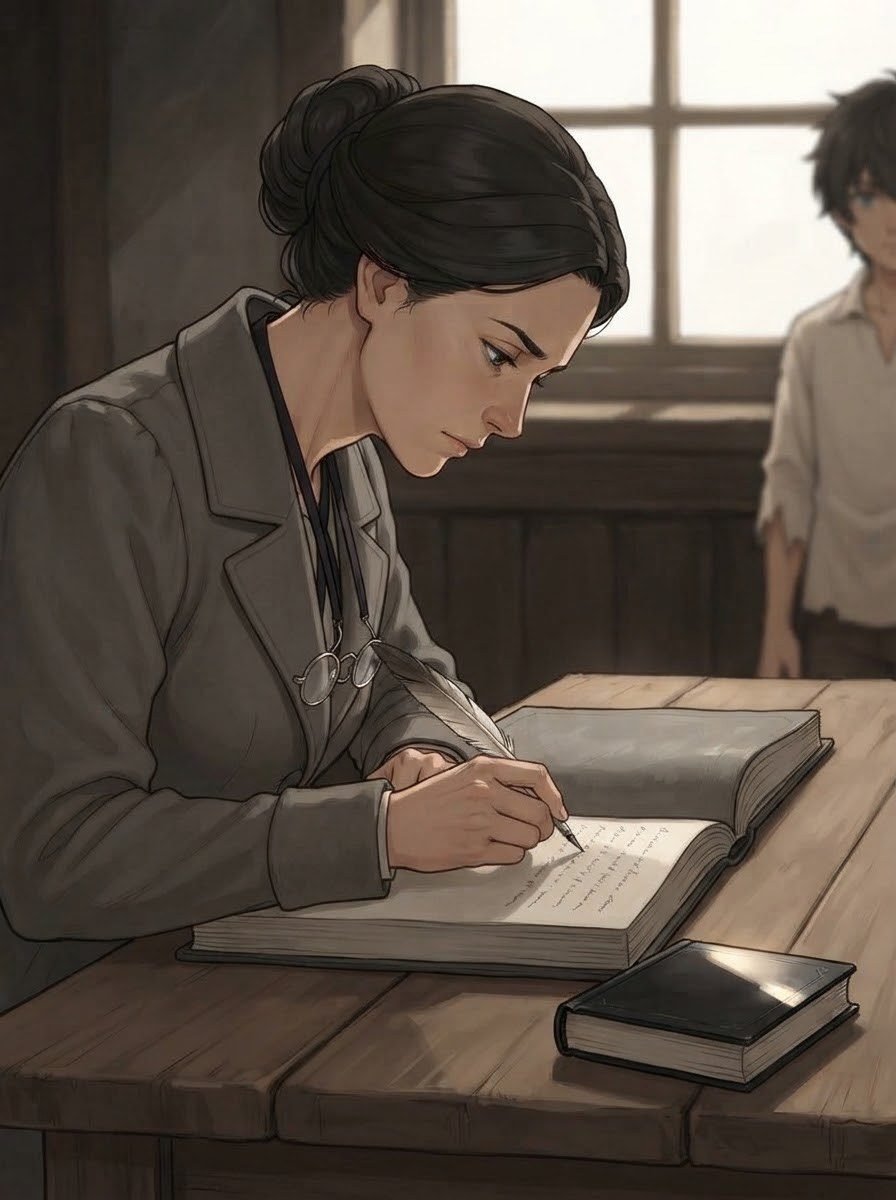
She was a woman of perhaps forty, in the same grey Keepers’ coat as Fisk but cut more neatly, with dark hair pinned up hard and spectacles on a ribbon that she put on and took off without seeming to notice she was doing it. A small brass badge on her collar said RECORDER. In front of her lay a great ledger bound in grey cloth, the Tournament score book, where she wrote down each entrant’s name as Fisk called it.
And beside the grey ledger, closed, there was a second book. Smaller. Bound in black. She did not open it once in the whole time Ash watched. But every so often, when an entrant came to the table, she would look up from the grey book and study them over her spectacles for a moment, with a strange flat attention, the way Ash’s mother studied a loaf before deciding whether it was done. Then she would look down again and write.
Ash found himself trying to guess who she would look at. She looked at Gerrod Mace, which was no surprise. She looked at a tall, narrow young man in a dark coat whom Ash did not know. She looked, for a long moment, at Tilda, which made Tilda go pink and furious. She did not look at Moss at all.
When Ash reached the front, Fisk said, “Name.”
“Ash Calder.”
“Age.”
“Sixteen.”
“Arms?”
Ash hesitated. “None.”
“Pathfinder, then. Runner. Climber.” Fisk wrote it down. “Fee’s paid by the Kites. Sign.”
Ash signed in the grey book. His name looked very small.
When he straightened up, the Recorder was looking at him over her spectacles.
She looked for longer than she had looked at Gerrod. Long enough that he felt his face go hot. Then she looked down at the grey book where he had signed, and her pen moved, and she wrote something next to his name that he could not read upside down. Just one short word.
Then she took off her spectacles and let them drop on their ribbon and said, without looking up, “Next.”
He did not sleep. Nobody in Ketterford slept much that night, because all night long the Fourway was full of hammering.
He lay under the beam with its notches and listened. Hammering, sawing, the long iron shriek of a cart axle that wanted grease, men calling to one another in the short flat vowels of the city. Once, near midnight, something very heavy was dragged across the cobbles at the end of Oven Row, slowly, with a sound like a giant clearing his throat, and Pim sat up in his blanket and said clearly, “That’s the wall,” and lay down again, asleep before he had finished lying down.
Ash thought about getting up to look. He thought about his father at the table. He lay still and counted notches, and somewhere around the fortieth the hammering became part of the dark.
When he came down Oven Row at first light, the market was gone.
Not gone. Changed. Somewhere in the dark, while the town lay awake listening, the Keepers’ men had come in with carts and lamps and taken the whole Fourway Market apart and built it again, wrong. The stalls were still there, most of them. But they had been moved and turned and joined edge to edge, and between them, filling every gap, stood great flat walls of rough planking higher than a man’s head, braced at the back with timbers. Where there had been a square there was now a maze. A box of a maze, filling the whole Fourway from wall to wall, with the well somewhere in the middle of it and the bell tower rising out of one corner like a mast from a wreck.
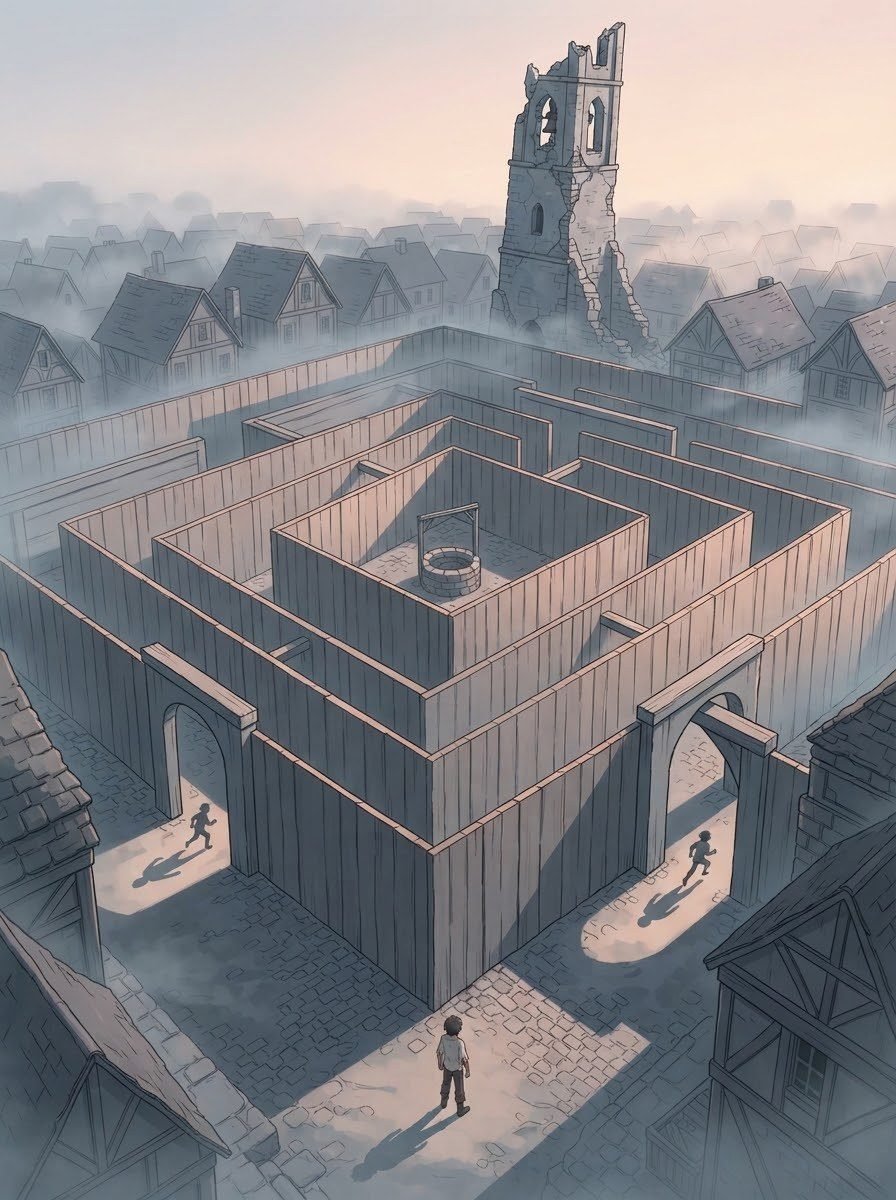
On each of the four roads where they came into the square, a gate had been built. A plank arch, painted grey, with a Keeper’s runner standing in it.
The men who had built it were sitting on the steps of the Keepers’ hall eating bread, and they did not look like Ketterford men. They wore grey canvas aprons and carried long measuring rods with marks painted on them, and they talked among themselves in the short, flattened accents of Stoneward. Coursewrights, the crowd whispered. Sent down from the city to build the Tournament, every year, the way they built every game in Greywold. Ash had never seen one before. One of them, an old man with a beard full of sawdust, looked up as Ash passed and met his eyes, and then went back to his bread.
On the outside wall of the maze, beside the west gate, they had nailed a board with the rules. A crowd stood in front of it already, reading, and the Recorder stood beside it in her grey coat, saying nothing, letting them read.
Ash pushed to the front. The board said:
ROUND ONE. THE STALLS MAZE.
Thirty-two tokens are hidden in the maze. Each is a brass disc marked with the Ketterford bell.
A player who passes out through any gate holding a token, before the noon bell, goes through to Round Two. One token, one player.
Arms Rule: Bare.
A token in hand may be won by a clean tag, open hand on the shoulder from behind, called aloud. A tagged player gives up one token. No player may be tagged in a gate.
Players may not climb the maze walls. A player seen on top of a wall is out.
At the half-bell the Keepers may change the gates.
By order. Gatekeeper Elam Fisk.
Ash read the line about the walls twice. A player seen on top of a wall is out. No sky road, then. He felt it like a door closing in his face. He had half planned for the roofs. Every boy in Ketterford knew about the awning now; of course the Keepers knew too. Of course they had heard.
He was still staring at the wall rule when Gerrod Mace’s big hand landed on his shoulder from behind.
“Morning, Kite,” said Gerrod warmly, loud enough for the crowd to hear. “Big day. Big day. Your mother’s bread this morning? Smells like it. Listen, a word, there’s a man from the Odds Hall over by the Weigh House I want you to meet—”
And he steered Ash away from the rules board and through the crowd, talking the whole way, about nothing, and by the time Ash got loose of him the board was ten deep in people, and the entrants were being called to the gates.