The Stalls Maze
Eighty-four entrants, the runners said. Twenty-one to a gate. Ash was sent to the west gate, the Stoneward Road gate, with Tilda and nineteen strangers. Moss went east. Gerrod Mace, Ash saw, went north, laughing with the runner at the arch as if they were old friends. Brint and Hask Mallory went south, together, which Ash supposed somebody had paid for.
They were counted in at the arch by a runner with a slate, one at a time, and made to stand in a line on the cobbles in the strip of shadow the plank gate threw. Some of them looked at no one. Some talked too loudly. A thin boy near the end was whispering the names of the four roads over and over under his breath, North, South, East, West, North, South, as though the market might have been rearranged in the night while he was not looking, which, thought Ash, it had.
The tall, narrow young man in the dark coat was at the west gate too.
Ash had seen him at the Keepers’ table, where the Recorder had looked at him for so long. Up close he was perhaps sixteen, Ash’s own age, with straight black hair cut very neatly and a narrow, clever, closed face. He stood a little apart from the others, quite still, his weight on the balls of his feet. His coat was dark grey wool, plain, and very good. On its lapel was a small pin in the shape of a reed, silver, bent as if by wind.
“Vell,” said Tilda in Ash’s ear. “Aric Vell. The cloth merchant’s son. His father owns half the looms on the Mill Road. He’s been away two years.”
“Away where?”
“Weirmouth. At the Reed School.” Tilda said it the way people said the Stitchery: a place real, but very far off, and not for the likes of them. “Blades. Fencing. They say he’s very good.” She sniffed. “They say a lot of things about people whose fathers own looms.”
Aric Vell turned his head and looked at them, as if he had heard. He had grey eyes, very light. They rested on Ash’s borrowed blue jacket for a moment, on the Kites’ sign stitched on its breast. Then they moved away, uninterested.
The Keepers’ bell began to ring for the start.
“Good luck,” said Tilda.
“You too.”
“I don’t need luck. I need a token and a straight road.” She tightened her cap. “If you see me bleeding, keep running. I can stitch myself.”
The runner in the west arch dropped his arm, and twenty-one bodies poured into the maze.
Inside, it was not the Fourway any more. It was a box of plank walls and narrow lanes and sudden turns, with stalls set into the walls like doorways, and everywhere the sound of running feet and shouting from lanes you could not see. The walls were too high to look over. The sky was a strip of pale blue overhead. Within twenty strides Ash had lost Tilda and everyone else, and was standing alone at a junction where three lanes met, with the sounds of the maze coming at him from all sides.
No sky road.
He stood still. Other players ran past him in both directions, shouting to each other, ripping covers off stall tables, kicking over baskets. Thirty-two tokens hidden in a maze the size of a market, and eighty-four people looking for them. It would be a scramble. The fast and the lucky would find them in the first hour. The rest would chase each other in circles until noon.
Every stall he could see, he knew. That was the strange part. The pie-woman’s board with the scorch mark where somebody’s brazier had once got away from them; the ironmonger’s hooks, turned now to face a plank wall, with a pair of kettles still hanging from them, shining stupidly in the strip of light; the corner of the well where he had sat at six years old with his feet in the gutter, eating the heel of a loaf. All of it was exactly where it had always been, and all of it was wrong, like a dream in which your own house has an extra door.
Ash did not want to scramble. He looked down.
The cobbles of the Fourway were older than anyone could remember, and they had been worn by carts for longer than that. Carts went round the well clockwise. Carts came in on the four roads and went out on the four roads. And over a hundred years, a thousand years, the iron rims had cut into the stones two shallow grooves, a cart-width apart, that ran through the whole market like the lines on a palm. Ash had walked over them every day of his life. Pushed the barrow in them. Watched rain run along them to the drains.
And the Coursewrights had built the maze in one night.
They had not carried those great plank walls in by hand. Nobody could carry them. They had brought them in on rollers and sledges and wheeled frames, the way you would bring in anything that heavy, and they had brought them in along the easiest road. Along the ruts. And once a wall was in place, they had not dragged it again over the bumpy cobbles; they had just turned it and set it down, beside the rut it had come in on.
Ash walked along the lane in front of him, looking at his feet. There. The twin grooves, running straight along beside the wall. He turned the corner. The grooves turned too, curving the way the carts curved round the well. He followed them. The lane opened. The grooves ran on.
Where the ruts ran, there was a lane. Where a lane crossed a rut and stopped, it was a dead end, built across the grain. The Coursewrights had laid their whole maze on top of the market’s old roads, and the old roads still showed through, under everyone’s running feet, like bones under skin.
He did not try to find a token. He followed the ruts toward the west gate, and the maze, for him, was simply the Fourway again: a market with walls in it.
There was a place, ten strides inside the west gate, where three lanes came together into one, and the one ran straight out through the arch. Ash had known there would be. The Stoneward Road was the busiest road into Ketterford, and three sets of ruts joined there, carts from the north side and the south side and the well, all funnelling onto the road out. The Coursewrights had built their walls along all three, and the three lanes met like streams meeting a river.
Every player who found a token on the west side of the maze would have to come through that one lane to reach the west gate.
Ash found a stall set into the wall just before the junction, the cooper’s barrel stall, turned on its side and built into the maze, and he sat down on an upturned barrel inside it, in the shade, where he could see all three lanes and the one lane out, and he waited.
It felt like cheating. It was not. It was on the board, in the Keepers’ own words. A token in hand may be won by a clean tag. The Keepers had made a game in which the tokens moved. They had not said a token must be found. Only held.
Still, he did not like it.
Time passed in the barrel stall the way it passed in the queue at the pull table: slowly, and then all at once. Over the wall to his left someone was weeping loudly and, as far as Ash could tell, with a certain satisfaction. Somewhere a stall-keeper was selling pies through a gap in the planks at double price to hungry players, and the runner on his ladder was carefully not seeing it. A pair of sparrows hopped along the top of the wall, which was the one place nobody was allowed to be, and looked down at Ash with their heads on one side.
He watched the three lanes, one after another, left, middle, right, and counted his breaths as he counted notches in the loft. Forty breaths. Sixty. The sun moved a hand’s width across the plank wall.
The first player through was one of the Mill Road brothers, running with a token in his fist held high like a torch, and Ash let him go. He did not know why. The boy went through the arch with a whoop. The second was a stranger, a big lad from Tallow Cross, and Ash let him go too. He told himself it was because they were moving too fast. It was not.
The third was Hask Mallory.
Hask came down the left-hand lane at a trot, alone, looking back over his shoulder every few strides. He had a token in each hand. Two. One of them had a smear of blood on it, fresh, and there was a scratch down Hask’s cheek that had not been there at the start.
Ash stood up out of the barrel stall, stepped in behind him as he passed, put an open hand flat on his shoulder and said, “Tag.”
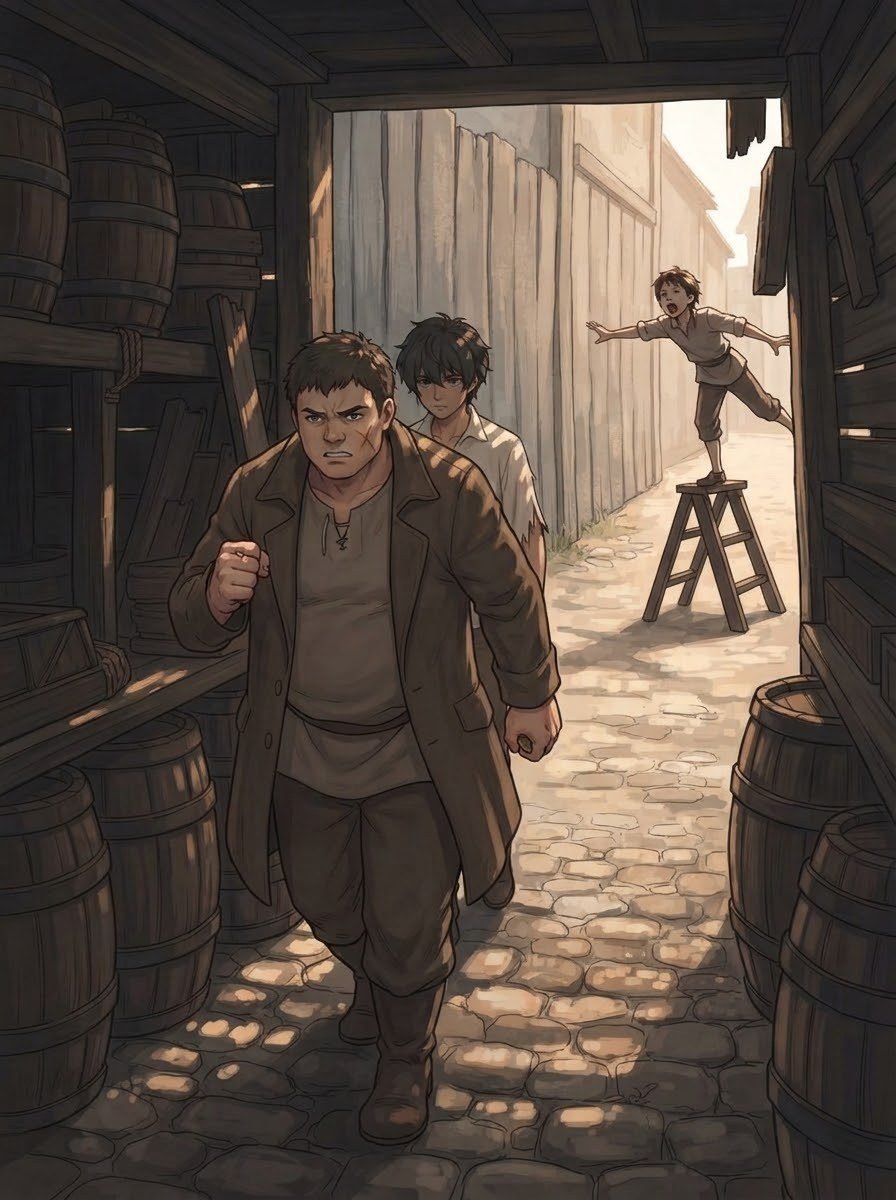
Hask spun. His face went through several things very fast. A Keepers’ runner, perched on a stepladder at the junction to watch for climbers, leaned over and called down, “Clean tag. One token.”
Hask stared at Ash. Then, slowly, he held out the token with the blood on it.
“Whose is that?” said Ash.
Hask’s lip curled. “Your little mender’s,” he said. “She wouldn’t let go.” And he turned and ran out through the west gate with the other one.
Ash stood in the lane with Tilda’s token in his hand. It was warm. It was a brass disc the size of a large coin, with a bell stamped on it, the old bell from the tower, and someone’s blood in the groove of the stamp.
He should go. He had a token. Twenty strides to the gate and he was through. He could see the arch from here, and the runner in it, and the daylight beyond.
He stood a moment longer than he needed to. It was a strange thing, how loud a decision could be when nobody else could hear it. Bette would have told him to go through the arch and not look back, because an arch was worth more than a stranger’s hand. His father would have gone through it without a word and thought about it for a month. Neither of them was here.
He turned the other way and went back up the left-hand lane at a run.