The Stalls Maze
He found her three turns in, sitting against a wall with her cap off and her hand wrapped in a strip torn from the hem of her own skirt, already soaked red.
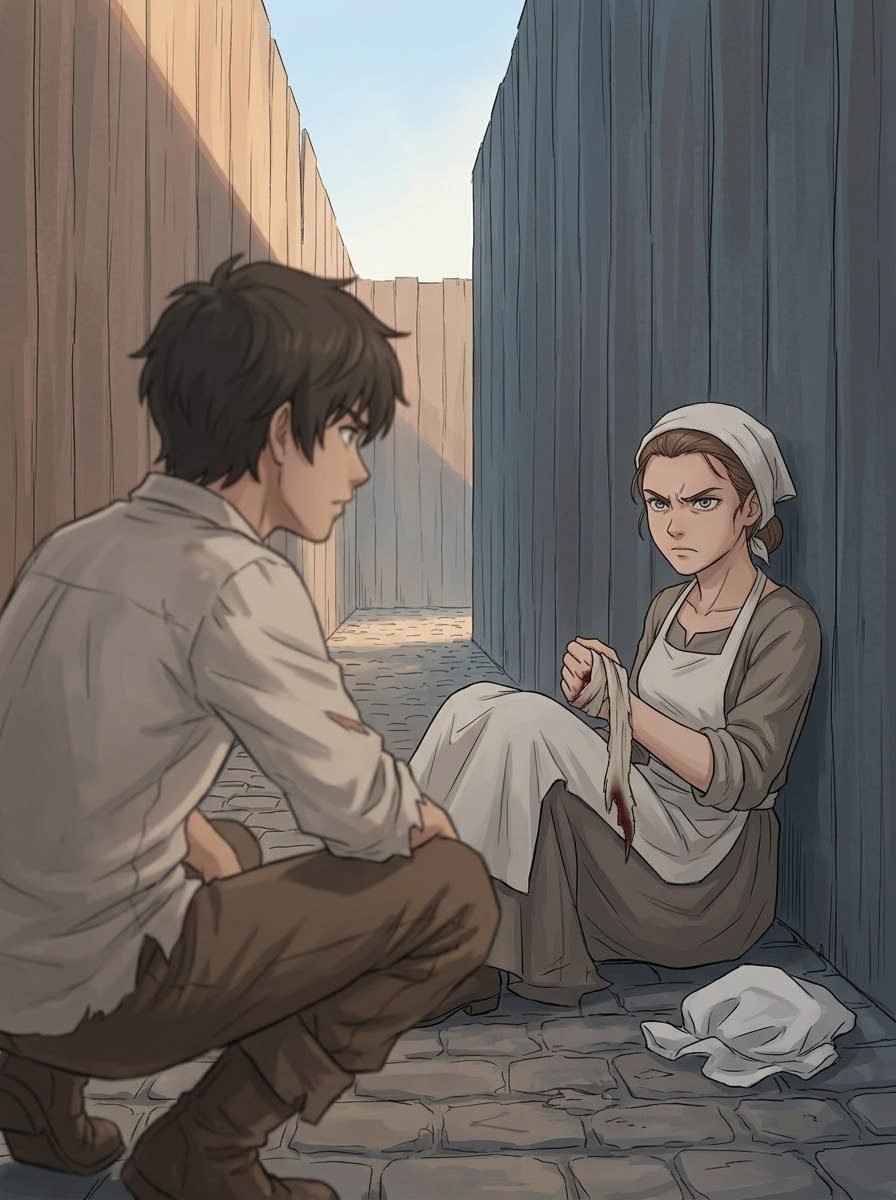
“He bit me,” Tilda said. She sounded more outraged than hurt. “He bit me. Bare rule. And the runner didn’t see because the Mallory brother, the big one, was standing in the way.” She looked up at him. “What are you doing here? Go.”
Ash held out the token.
Tilda looked at it. She looked at him. She did not take it.
“That’s mine,” she said.
“I know.”
“Then why haven’t you got one of your own?”
“I’ll get one.”
“Before noon? You’ll get one before noon?” Tilda’s face did something complicated. “You absolute idiot. You had a token in your hand at the gate and you came back.”
“It’s yours.”
“It’s a brass disc!” She snatched it out of his hand and then, very carefully, put it back in his palm and closed his fingers over it with her good hand. “Listen to me. I’m a mender. I was never going to win this. I was going to get to the Climb, maybe, if I was lucky, and get my name in a book. And now I’m bleeding in a maze with my hand bitten by a Cobble Down rat, and I’m going to spend the next round standing by the ford with a bag of bandages, helping the Stitchery woman, which, if you think about it for one heartbeat, is a far better way of getting into the Stitchery’s book than falling off a tower.” She let go of his hand. “Go and win, you idiot. And when you get to the ford, if you break anything, come to me first.”
Ash looked at the token in his fist.
Then, somewhere above them, the Keepers’ bell rang once.
The half-bell.
And from the direction of the west gate, faint over the walls, came a long groaning scrape of wood on stone, and a shout, and then many shouts, and Ash remembered the last line on the rules board. The one he had read and not read, with Gerrod’s big hand on his shoulder, pulling him away.
At the half-bell the Keepers may change the gates.
He ran back toward the west gate anyway, because he had to see. Tilda shouted something after him. He did not hear it.
The funnel lane was full of people. A dozen players, maybe more, all crammed into the last ten strides before the arch, and all of them were shouting, because the arch was not there any more. Where it had stood, there was a wall. A great section of rough planking, as high as the others, braced at the back, set across the lane from side to side as if it had always been there. In the gap above it Ash could see the Stoneward Road and the roofs beyond, and the sky, and a Keepers’ runner on a stepladder on the far side looking down at them all with a face of professional boredom.
“West gate’s closed,” the runner called, for what was clearly the tenth time. “Gates have changed. Find an open one.”
“WHICH one?” someone screamed.
The runner shrugged. “That’s the game.”
Ash stood at the back of the crowd and looked at the wall across the lane. At its bottom edge, where it met the cobbles. The Coursewrights had not carried this section in by hand either. It sat on two heavy runners, like a sledge, shod with iron. And from under the iron runners, leading back along the lane and round the corner to the right, there ran two bright new scratches in the grey cobbles, pale as chalk lines, where the iron had scraped the stones as the wall was hauled into place.
The west gate had been closed by a wall that came from somewhere else. And if a wall had been taken from somewhere, something else was open now.
Ash turned and followed the scratches.
They went round the corner, along a lane he had walked an hour ago, and round another corner, and they ran all the way back along the north side of the maze toward the tannery lane, where the Quarry Road came into the square. And at the end of them, where they began, there was a gap in the maze wall that had not been there that morning. A wide gap. With fresh scratches leading out of it, and cobbles beyond it, and beyond the cobbles, the narrow mouth of the tannery lane.
And beyond that, at the very end of the lane, grey and plain, an arch. With a runner standing in it.
He was halfway down the new lane, running, when he heard Moss.
He heard him before he saw him, which was normal. Moss was somewhere to the left, behind a wall, apologising.
“Sorry. Sorry, excuse me. Is this the way to—no, I see it isn’t. Sorry.”
Ash stopped. To his left, a lane ran away from the scratch trail, deeper into the maze. He followed the voice. Two turns in, he found Moss Barlow standing at the end of a dead-end lane, facing a blank wall, holding a brass token in one big hand and a small wicker bread basket in the other.
“Ash!” Moss’s whole face lit up. “It was in a bread basket! On the chandler’s stall! Under a loaf! It’s not even a good loaf.” He held up the basket as if Ash might want to judge for himself. “Then I went to go out of the east gate, and it was gone, and there’s a wall there now, and then everyone was shouting, and I came this way because nobody else was coming this way, and then this way stopped.”
“Nobody else was coming this way because it’s a dead end.”
“Ah,” said Moss. “Yes. I worked that out.”
“Come on. North gate’s open.”
“How do you know?”
“Because the walls had to come from somewhere,” said Ash, already running. “Drop the basket.”
Moss looked at the basket. Then he put it carefully on the ground against the wall, the way you would leave something for its owner to find, and came after him.
They came out of the maze into the tannery lane with the sun nearly at the top of the sky. Only a few other players had found the north gate. Ash could see two ahead of them, already through the arch. The lane was narrow here, with the backs of the tanneries on one side and the last of the maze walls on the other, and the smell of the tan pits so thick you could lean on it.
“Go,” said Ash. “Go through first.”
Moss went. He jogged down the lane with his token held out in front of him as if it might try to escape, and passed under the arch, and the runner there looked at the token and nodded and waved him on. On the far side Moss turned round in the Quarry Road and threw up both arms like a man who had just won the whole Tournament, and some of the crowd waiting there laughed and cheered him.
Ash grinned and started down the lane after him. Twenty strides. Fifteen. Tilda’s token was hot in his fist. She had made him keep it; she had said she would rather be robbed by an idiot than a Mallory.
A hand landed on his shoulder from behind. Light and flat and very precise.
“Tag,” said a quiet voice.
Ash stopped dead.
The runner in the arch called, “Clean tag. One token.”
Ash turned round.
Aric Vell stood behind him in the tannery lane, in his good grey coat with the silver reed on its lapel, not even out of breath. He held out his hand, palm up, the way the Warden had held out his for the stone, and he waited.
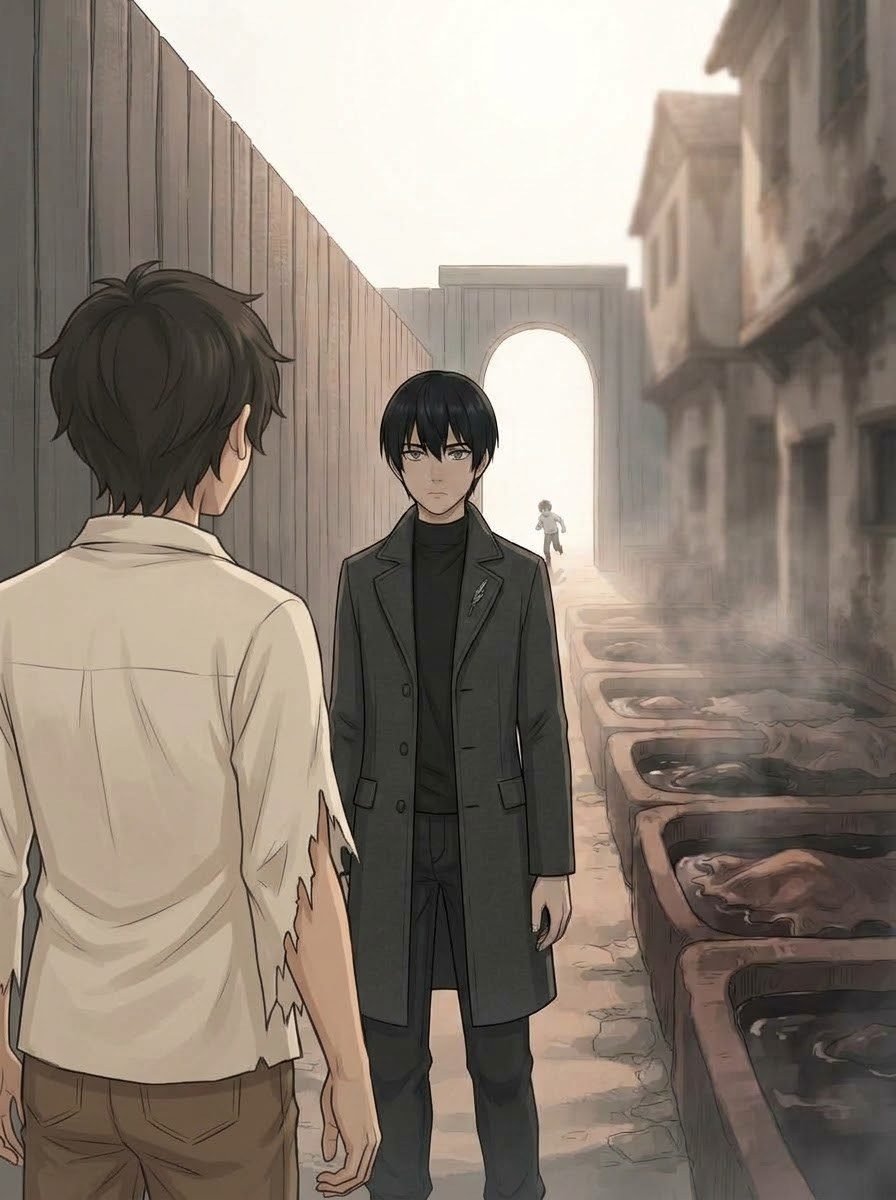
Ash looked at the hand. He looked at the arch, ten strides away, and the sun nearly overhead, and Moss on the far side with his arms slowly coming down, and his face slowly falling.
There was nothing to do. It was the rule. He had used it himself, on Hask, an hour ago.
He put Tilda’s token in Aric Vell’s palm.
Aric closed his hand on it. He did not go to the arch. He stood there in the stink of the tan pits and looked at Ash with those light grey eyes, as if Ash were a problem in a book he had not been able to solve.
“You let the Mill Road boy go,” he said.
Ash said nothing.
“At the funnel. By the west gate. I was in the stall across the lane from yours, the potter’s. I’d been there since before you sat down.” Aric’s voice was low and very clear, with the clipped edges of somewhere that was not Ketterford any more. “I’d already found a token. In the first hundred strides. They hide them where any fool would look and I’m not a fool. So I thought I’d sit at the funnel and take a second, to be safe. And then you came along the ruts, looking at the ground, as though you knew exactly where you were going. And you sat down across from me. And you let two players go past with tokens in their hands before you took one.” He paused. “And then you went back. For a girl with a bitten hand. With a token in your fist and the gate ten strides off.”
“She’d already been robbed once.”
“Yes,” said Aric. “I watched that too.” He tipped his head toward the maze. “Then the walls moved. And everybody panicked. Everybody except you. You looked at the ground and followed something, so I followed you. I didn’t look at a single wall after that. I just watched your back.”
He opened his hand. Two tokens lay in it. His own, and Tilda’s.
“So I know I could take this,” said Aric Vell. “Rules are rules. And I’d be through with two tokens, and you’d be out, and that would be that.”
He took Ash’s hand, turned it palm up, and put Tilda’s token in it.
“But you read the ruts,” he said. “I just followed you. That’s not winning. That’s a dog finding its way home behind a cart.” Something moved in the narrow, closed face, something that might, on another person, have been a smile. “I didn’t come back from Weirmouth to beat a boy who carries bread by following him. I came back to win the Ketterford pass properly. In front of everyone. Against the best this town has got.”
He stepped round Ash and walked down the tannery lane toward the arch, his own token held loosely in his fingers, not hurrying.
At the arch he stopped and looked back.
“I’ll see you on the tower, Kite,” said Aric Vell. “Don’t make me wait.”
Then he went through, and the noon bell began to ring, and Ash stood alone in the tannery lane with a bitten girl’s token in his hand and ran the last ten strides of the morning with his heart going like the bell.