Carry Line

The stonecutter chalked the names of the thirty-two on a long black board beside the Tournament stone, and by the middle of the afternoon half of Ketterford had come to read it.
Ash read it from the back of the crowd, where Pim had dragged him. His own name was eleventh. A. CALDER, KITES. Moss was twenty-fourth. Aric Vell’s name was first, because his token had been the first through any gate, a long way ahead of everyone else, and under it the stonecutter had written, in smaller letters, REED SCHOOL, as if that explained it.
Gerrod Mace was there. The Mallory brothers were there, both of them, eighth and ninth. Arn of the Mill Road was there, and Neve Pask but not her sister, and a dozen names Ash did not know from Tallow Cross and the Mill Road and the farms.
Tilda Penn was not there.
Pim found the gap where her name should have been and put his finger on it and looked up at Ash, and Ash shook his head, and Pim took his finger away very quickly as if the board had become hot.
Tilda herself did not seem to mind. Or she did not show it. When Ash found her she was sitting on the steps of the Stitch Room with her bitten hand freshly bandaged by someone who was clearly not her, because she kept glaring at the knot, and beside her sat the Stitchery woman.
Ash knew her at once. The lean, quiet mender from the caravan, the one Bette had paid two stones to look at their father’s leg. She had a long, plain face, burnt brown by road weather, and grey hair cut short as a boy’s, and on the shoulder of her travelling coat the Stitchery badge: a needle crossed with a bone, worked in white thread.
“Ash Calder,” she said, before he could speak. “The carter’s boy. I wondered.” She looked at him with mild interest, the way she had looked at his father’s leg. “Mender Corva Lind. The Stitchery sends me to your Tournament every year, to sit by the river and pick up the pieces. This year I’ve an assistant.” She nodded at Tilda. “Who tells me she was bitten.”
“She was bitten,” said Ash.
“So I see. Clean bite. No harm done that won’t mend.” Corva Lind stood up and dusted off her coat. “She’s going to stand with me at the ford tomorrow. If any of you idiots break yourselves on the Carry Line, she’ll be the first one to curse you while she splints you. I’m told she’s very good at the cursing.”
“The best,” said Ash, with feeling.
Tilda gave him a look that could have cut leather. But when the mender had gone inside, she said, without looking at him, “She asked my name. She wrote it down. In a little book.”
“That’s good.”
“I know it’s good.” Tilda scowled at her bandage. “I didn’t need you to give me my token back to get it, either. I want that understood.”
“Understood.”
“Good.” She was quiet a moment. “Thank you for giving me my token back.”
Ash went home the long way, through the tannery lane and along Oven Row, and found the loft already lit.
Bette was sitting on the bottom rung of the ladder with his good boots across her knees, a rag in one hand and a tin of tallow beside her, working the grease into the seams as though the seams had insulted her. She did not look up when he came in.
“You’ll want these dry,” she said. “The left one was split at the welt. I’ve sewn it. It’ll hold as far as the ford and not a stride after, so don’t go leaping about.”
“I won’t leap.”
“You’ll leap.” She turned the boot over and rubbed harder. “There’s porridge on the shelf. Eat it before Pim finds it. He’s had two bowls already and told me one was for you, which is the sort of lie only a nine-year-old can tell with a straight face.”
Ash sat on the floor with the bowl between his knees. The porridge was cold and had a skin on it, and he ate every bit. Above them the loft beam creaked as the oven below settled, the way it did every night, and the warmth came up through the boards and into his back.
“Somebody left a cake on the step,” Bette said. “No name on it. Sticky. I’d say it came from the bakery and I’d say it was meant for Moss, so you can take it round to him in the morning, and not eat any on the way.”
“I won’t eat any.”
“You’ll eat a corner.” She held the boot up to the lamp and squinted down the length of it. “Nobody in this house is going to tell you to stop, Ash. You know that. Father said it once and he hasn’t said it twice, and I think he’s sorry he said it even once. But if you fall in that river tomorrow I am going to be extremely angry.”
“If I fall in the river I’ll be too wet to notice.”
She threw the rag at him. It hit him in the face. It smelled of tallow and smoke and home, and for a moment, with the bowl in his hands and Pim snoring in his blanket and his sister pretending not to smile, Ash thought that whatever the morning did to him, this would still have been a good evening to have had.
Gerrod Mace came to find him that night.
He did not come to the house. He came to the yard wall behind it, after the oven had been banked, while Ash was hauling water for the morning, and he leaned on the wall in the dark and said “Kite,” quietly, and Ash nearly dropped the bucket.
The captain looked different in the dark. Less handsome, more tired. He did not smell of ale tonight. He smelled of nothing at all.
“Carry Line tomorrow,” he said. “Sixteen pairs. Top eight go through to the duels.”
“I know.”
“There’s a pair from Cobble Down. The Mallory boys.” Gerrod picked at the moss on the top of the wall. “I need them through. Both of them, into the duels.”
Ash put the bucket down.
“At the ford,” said Gerrod, “you’re going to have trouble. You’ll slip. Lose a few strides. Nobody’ll think twice. The ford’s hard. Let them past you on the way back and then come in behind them. You’ll still make the eight, likely. You and the baker are strong. You’ll just be a bit slower.”
“Why?”
Gerrod looked at him. In the dark his face was hard to read.
“Because I’ve asked,” he said. “Because the Kites paid your fee.”
“That’s not why.”
For a moment something showed on the captain’s face, something that was not friendly and not warm and not anything Ash had seen there before. Then it was gone.
“No,” Gerrod agreed. “It isn’t. But it’s the only why you’re getting.” He pushed himself off the wall. “Slip at the ford, Ash. It’s a small thing. A few strides. Nobody gets hurt.”
“No.”
Gerrod had already half turned away. He stopped.
“I’m not slipping,” said Ash. His voice sounded strange to him, very young and very steady at the same time. “Not at the ford. Not anywhere. If the Mallorys want to go through, they can carry their stone faster than me and Moss.”
The captain stood in the dark lane behind the Calder house for a long time, looking at him.
“All right,” he said at last, very gently. “All right, Ash. You do what you think is right.”
Then he walked away, and Ash stood by the bucket and found that his hands were shaking, and did not know why, because nothing had happened. Nothing at all.
The stretchers were kept overnight in the Kites’ hall.
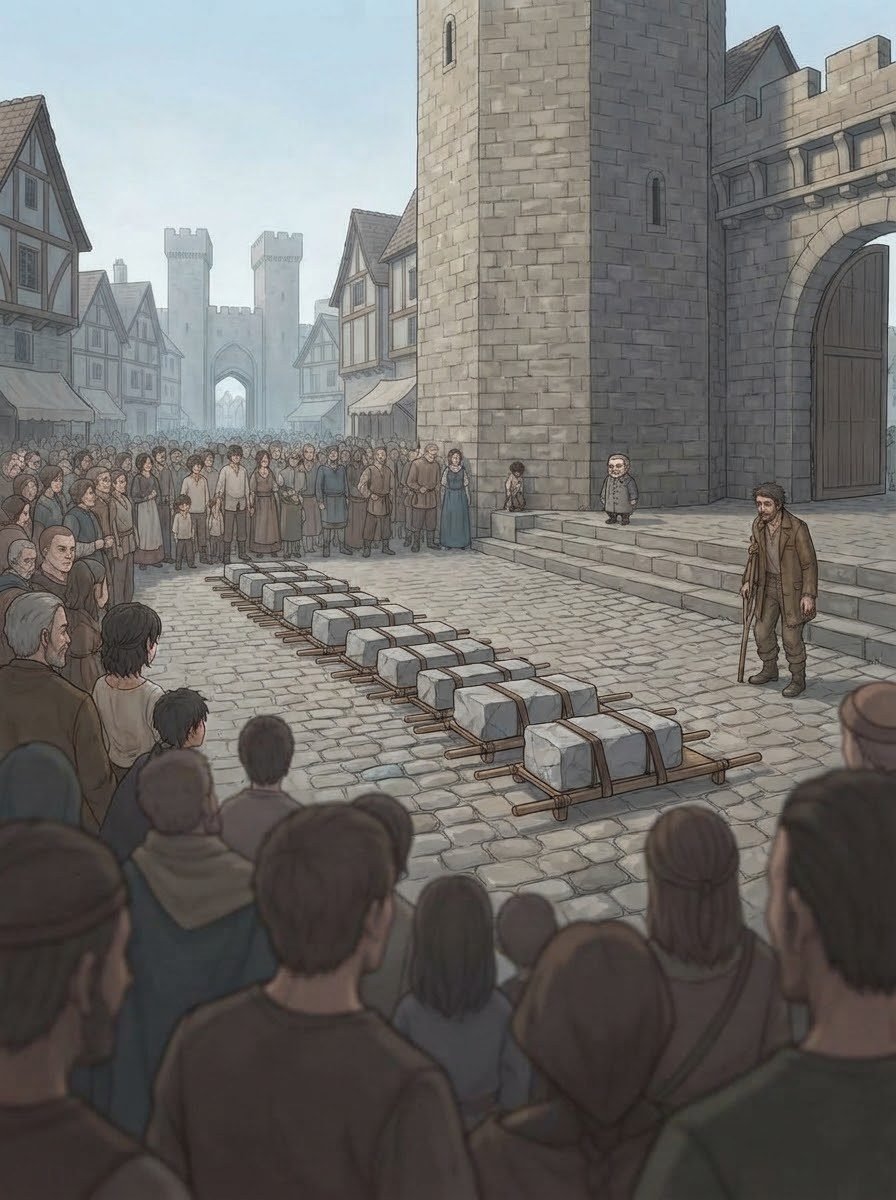
Ash found that out in the morning, standing in the square with the other thirty-one entrants while Gatekeeper Fisk read the rules from the tower step. Sixteen stretchers, built by the Coursewrights from ash-wood poles and canvas, lay in a row on the cobbles in front of the tower, each with a block of grey quarry stone strapped to it. They had been made in Stoneward and brought down by cart, and since the Kites’ hall was the only building on the square with a floor big enough, the Keepers had stored them there, as they did every year.
Pairs drew lots for stretchers. Moss drew the eleventh. Ash looked at the eleventh stretcher and saw nothing wrong with it at all.
“The course,” said Fisk, in his voice like a door closing. “From this step, out by the north gate, down the Quarry Road to the ford. Across the ford. Up the old road to the spoil heap at Pitch End, to the Keepers’ flag on the top of the spoil. Round the flag. Back down the spoil, back across the ford, back up the Quarry Road to this step. Stone stays on the stretcher. Stone touches the ground, you carry it back to the last Keepers’ post you passed and go again from there. Arms Rule is Bare. No one touches another pair’s stretcher or stone. First eight pairs to this step go through to the duels. Menders at the ford.” He looked down the line. “Any player who can’t go on, leaves the stone where it falls and walks off the course. Nobody dies for a rock in my Tournament. Understood?”
Thirty-two voices said they understood.
Ash looked across the line at Aric Vell. Aric had paired with Arn of the Mill Road, which was clever: Arn was the fastest runner in Ketterford on the flat, and light, and he did what he was told. They were standing beside their stretcher with their hands loose at their sides, saying nothing to each other, as though they were waiting for a cart.
Gerrod Mace had paired with one of the Kites’ juniors, a broad-shouldered boy named Tobbin Fale. Gerrod did not look at Ash once.
The Mallory brothers stood beside their stretcher, the fourth. Brint was looking at Ash. He did not smile.
And behind the line, at the edge of the crowd near the north gate, leaning on a crutch, in his old carter’s coat, so still among all the shoving bodies that Ash nearly did not see him at all, was his father.
Ash’s breath stopped in his chest.
Hollis Calder was not looking at him. He was looking at the stretchers. At the stones on them, grey quarry stone from the pits at Pitch End, the same stone that had come down the north face two winters ago. His face was set like the stone itself.
He had said no. He had said that’s the end of it. And he had walked from Oven Row to the square on that leg, through the market-day crowd, on his crutch, and he was standing at the north gate, where the course went out.
“Ash,” said Moss beside him. “Ash. We’re picking up.”
Ash bent and took hold of the front poles. Moss took the back. On the tower step, Fisk raised his hand.
When Ash looked again, his father was gone from the edge of the crowd, and Ash did not know if he had imagined him.