Carry Line
The splint held for a long way. It held up the first slope of the Quarry Road and past the first Keepers’ post and halfway up Tanner’s Hill. Then, under the weight, on the steepest bit, Quent’s twine began to stretch, the way all wet hemp stretches, and the broken pole began to bend again, a little, then a little more.
They stopped. Ash did not need to say anything. Moss came round and looked at it, and at him.
“Shoulders,” said Moss.
They lifted the whole stretcher, poles and all, and put the poles on their shoulders. The front pair on Ash’s, the back pair on Moss’s. It was not how the stretcher was meant to be carried. Nothing in the rules said they couldn’t. The stone rode above them, level, high off the ground, like a lord in a litter. It was much heavier this way. The poles ground into the bones of Ash’s shoulders with every step until he could not feel anything there but a long burning bar.
They climbed Tanner’s Hill like that. People came out of their houses to watch. The children who had followed them on their training mornings ran beside them shouting, left, right, left, right, and for once Ash did not mind.
Halfway up Tanner’s Hill an old woman in a doorway held out a cup of water on her flat palm, the way you hold something out to a nervous animal. Ash could not take it, because he had no hand free, and she seemed to understand that at once, and tipped it, very gently, over his burning shoulder instead. It ran down inside his shirt as cold as the river had been, and he could have wept for it.
A man with a handcart saw them coming and pulled the cart into the gutter to give them the whole road. He did not cheer. He touched two fingers to his cap, once, and looked away, as one carter does to another. Nobody cheered at that spot, in fact. They only made room, and Ash found that he liked it better than the shouting.
The pole ground at the bone of his shoulder. To keep from thinking about it he thought about the clean pale line on the underside of the wood. Slip at the ford, Ash. It’s a small thing. A few strides. Nobody gets hurt. He thought about the Kites’ hall, and the long row of stretchers lying in it all night with the doors shut, and about who has a key to a hall like that, and who does not need one.
Then the pole shifted, and he stopped thinking about anything at all.
At the top of the hill, where the Quarry Road turned into the north gate and the square opened up beyond, Ash heard Moss make a noise behind him that he had never heard Moss make before. A small, high noise, like a dog that has been stepped on. And he felt the back of the stretcher drop, just a little, on the right.
“Moss—”
“Keep going.”
“Your shoulder—”
“I know about my shoulder. It’s my shoulder.” Moss’s voice was very strange and flat. “Keep going. I’m not stopping. I’ll never forgive you if I stop. Go.”
They went in through the north gate, and across the square, and the noise was like a wave breaking. Forty strides. Thirty. Ash could see the tower step now. Aric Vell and Arn sitting on it, already finished, quite dry, their stretcher neatly laid out on the cobbles. Brint and Hask Mallory sitting on the next step down, soaked and furious. Four other pairs. Gerrod was not there.
Twenty strides. Ten. The Gatekeeper on the step with his hand raised. Five. Ash heard Moss behind him, not breathing so much as sobbing, and the stretcher tipped, and tipped, and he thought no, no, not now, and then the bottom step was there and they put the stretcher down on it, stone and all, and Fisk’s voice came from somewhere above saying “Seven,” and Moss sat down on the cobbles very slowly and went white.
His right arm hung wrong. Ash could see it even through the soaked shirt. The shoulder had gone out of its socket, the round of it pushed forward under the skin like a knot in wood.
“Oh, you complete idiot,” said Tilda Penn, arriving at a run from the Quarry Road with her bag banging against her hip and her face white with fury. She dropped on her knees beside Moss. “Hold still. Hold still. You carried a stone up Tanner’s Hill with your shoulder out? You walked it?”
“Only the last bit,” said Moss faintly.
“Only the last—” Tilda put one foot against his ribs and took his wrist in both hands. “Look at Ash. Look at him. Don’t look at me.”
Moss looked at Ash. Ash looked back. Moss tried to smile.
Tilda pulled.
There was a sound like a knot coming undone. Moss said a word Ash had never heard him say, and all the colour came back into his face at once, and he sat there blinking with tears running down his cheeks, and said, “Oh. Oh, that’s better. That’s much better. Thank you. Sorry.”
“Don’t thank me. Don’t move it. You’re out of the duels,” said Tilda, already binding the arm to his chest. “Don’t argue. You can’t hold a staff, you can’t lift a loaf. If I see you holding anything heavier than a cup for a month, I’ll put it back out myself.” She did not look up. But her hands, Ash saw, were shaking. “Seven. You came in seventh. With your shoulder out. You stupid, stupid—” She stopped. She bent her head and finished the knot. “Well done,” she said quietly. “Both of you.”
Corva Lind came across the square more slowly than Tilda had, with her hands in her coat pockets, and stopped beside the kneeling pair and looked at the strapped arm for a long moment without touching it.
“Who put that back?” she said.
“I did,” said Tilda, without looking up. Her chin was out. “I know I should have waited for you. He was going white.”
“I wasn’t criticising.” The mender crouched, and ran two fingers along the collarbone, and across the front of the shoulder, and Moss winced. “Clean. Straight back in, no pinch, no scrape. I’ve seen men with ten years of road behind them do it worse.” She sat back on her heels. “A month in the sling. No lifting, no hauling, no ovens. If he tells you otherwise, he’s lying, and you may put it out again.”
Tilda’s ears had gone red. She bent her head over the knot again and said nothing, but Ash saw her mouth shut very tight on something that was trying very hard to be a smile.
“Thank you,” said Moss, to the mender, with enormous dignity, like a man thanking a duke.
Then he sat there, grey in the face and grinning, and did not seem to feel a thing.
Gerrod Mace and Tobbin Fale came in ninth, a long time later, after the eighth pair. They were out.
Ash watched Gerrod walk up to the step and see the board. Watched him read it. Eighth: Pask and Pask. Watched his face not change at all. Then the captain turned and looked across the square, straight at Ash, and Ash looked back, and neither of them said anything, and after a moment Gerrod walked away into the crowd.
Out, Ash thought. He’s out. He can’t be in the duels, he can’t be in the Climb. He can’t tell me anything now.
And then, even as he thought it: So why does he look like he’s won?
“Boy.”
The voice came from behind him. Ash turned.
His father was standing by the stretcher on the bottom step, leaning on his crutch. Hollis Calder had come across the whole square on that leg, through all that crowd. He was not looking at Ash. He had bent down, slowly, painfully, and he was running his thumb along the underside of the broken pole, under Quent’s twine, where the break was.
He had spent twenty years hauling stone on ropes and wood. Twenty years of axles and shafts and poles that cracked under weight. He knew how wood broke. Ash watched him feel the clean, pale line across the underside of the ash-wood with the tip of his thumb, back and forth, very slowly, the way the Stitchery mender had felt along his leg.
Then Hollis straightened up, and looked at his son for the first time that day.
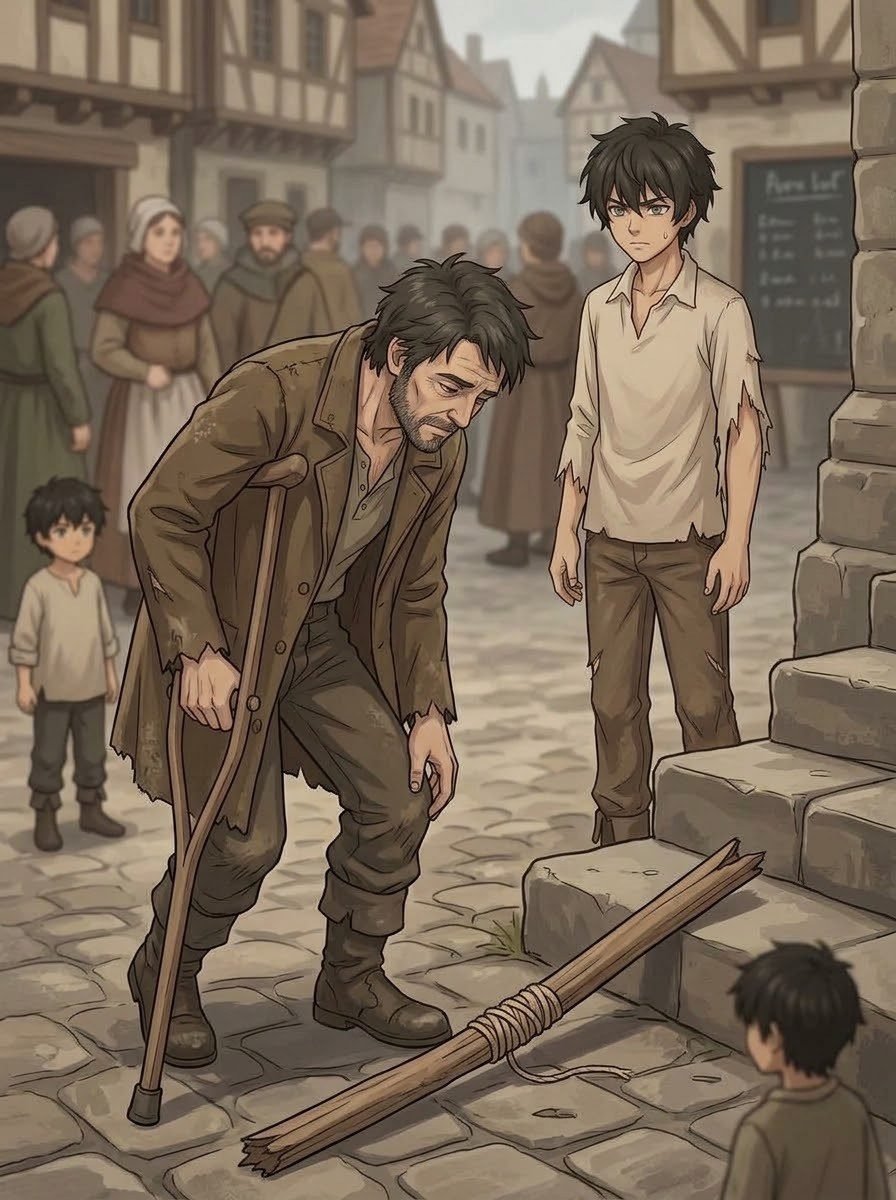
“That was cut,” he said quietly. “Underneath. With a fine saw. Where the canvas would hide it.” His face was like the stone on the stretcher. “Who kept these poles last night, Ash?”
Ash did not answer. He did not have to.
Across the square, a boy on a ladder was chalking the duel bracket onto the black board for the third round. Sixteen names, in pairs, drawn by lot by the Gatekeeper: who would fight whom with padded staffs in the ring tomorrow morning, first to three touches, winner on to the next.
The crowd around the board went quiet, then loud, then quiet again, and Ash saw people turning to look at him. Pim came running across the cobbles, pushing between legs, his face white, and grabbed Ash’s wet sleeve in both hands.
“Ash,” Pim whispered. “Ash, it’s not fair. Look. Look who they’ve given you.”
Ash looked.
The first line of the bracket, in fresh yellow chalk:
A. CALDER, KITES — against — G. MACE, KITES.
Under it, a little smaller, in the stonecutter’s careful hand:
G. Mace restored to the draw by the Gatekeeper’s leave, in place of D. Pask, hurt on the spoil, who withdraws.
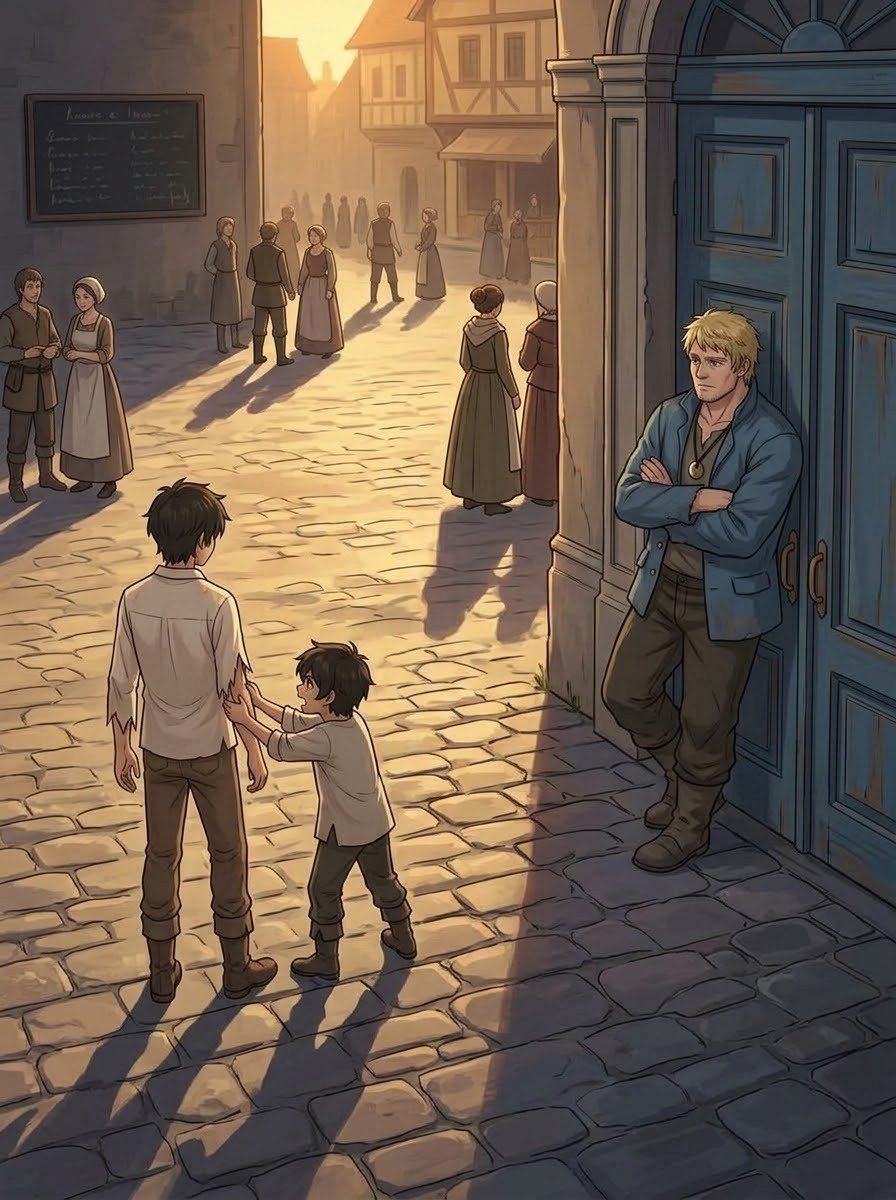
On the far side of the square, by the Kites’ hall, Gerrod Mace was leaning against the blue doors with his arms folded and the pass glinting on its cord around his neck. When he saw Ash looking, he lifted one hand, and smiled, and gave him a small, friendly wave.