The Full House
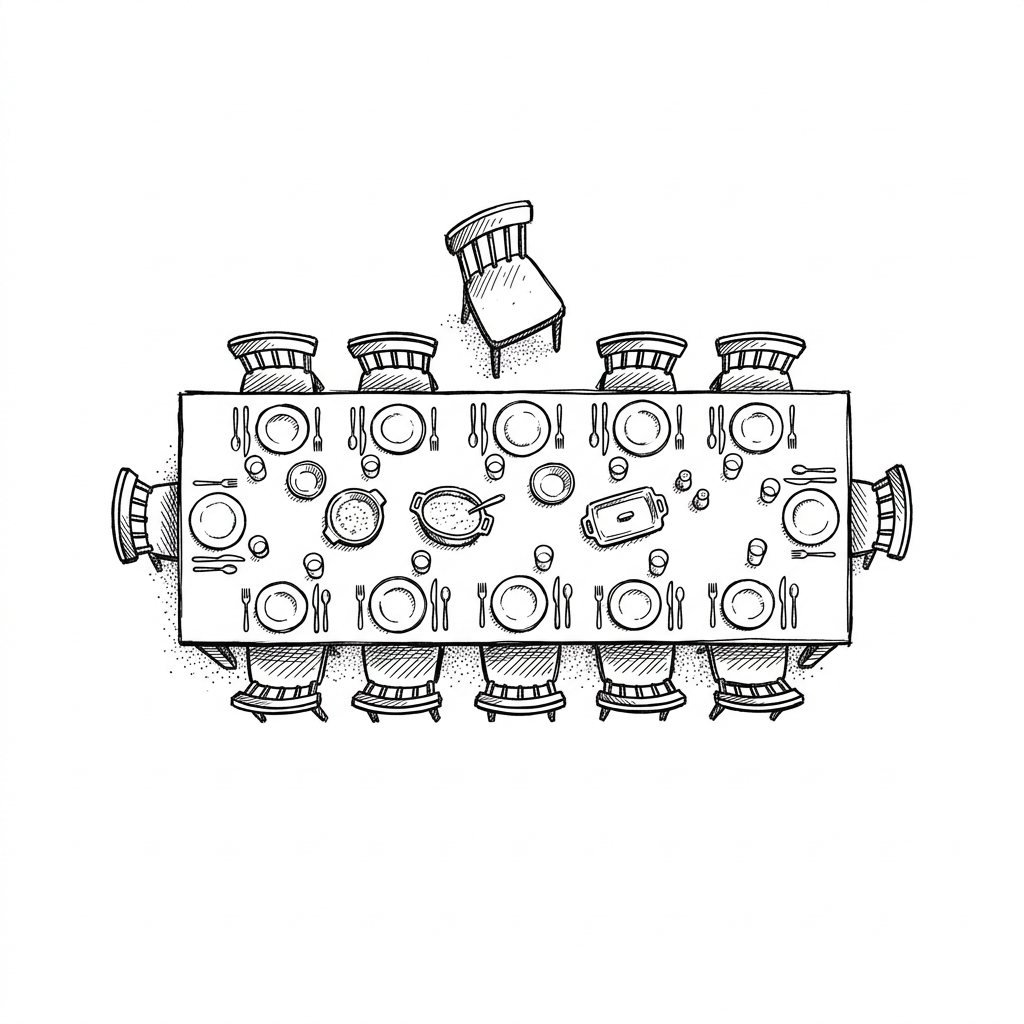
There is a particular sound a house makes when it is completely full, and I have been chasing it, in one way or another, for the rest of my life.
It is not one sound. It is forty small ones laid on top of each other until they stop being sounds at all and become a kind of weather. Someone frying. Someone scolding a child who is not theirs, freely, the way you could in those days. Two men arguing about a cricket match from nine years ago as though the result were still in doubt. The particular hiss of a pressure cooker that everyone has learned to ignore except my mother, who could tell you from three rooms away exactly how many minutes it had left. Underneath all of it, low and constant, the murmur of people who have known each other their whole lives and have run out of new things to say and are perfectly, gloriously happy to say the old ones again.
The house filled like that every Eid. The relatives came in from the other cities — off buses, off trains, out of borrowed cars, spilling children and bedding and tins of things their own towns were famous for — and for three or four days our modest house held twice what it was built to hold and did not complain. My mother became something more than herself in those days. She did not sit down. I am not exaggerating for the sake of the story: I have a great many memories of my mother on her feet in that house and almost none of her in a chair. She moved through the crowd of us the way a conductor moves through an orchestra that has grown too large for the stage, and somehow every plate stayed full and every guest stayed warm and no one ever saw the cost of it, which was, of course, her.
This is the warmth I want you to stand inside for a moment before anything goes wrong. Because a great deal is about to start going wrong, and none of it will be the house’s fault.
My grandfather kept a corner. He always kept a corner — a low seat by the window where the light was good, from which he could watch the whole roaring business of the family without being pulled into any single part of it. Children were brought to him to be admired and then taken away again. He admired them all with the same unhurried attention, one at a time, his thumb moving over their small heads the way it moved under the words on a Friday. I used to sit near his corner when the noise became too much, not touching him, just inside the quiet he carried around with him like a coat.
And then there was Bilal.
I should tell you about Bilal now, because he is going to sit at the edge of the rest of this book, and it will be important that you understand him correctly, which is more than I managed for twenty years. Bilal was my cousin — my aunt Rehana’s son, close enough to my own age that we were forever being measured against the same doorframe and told how we’d grown. He was the sort of boy for whom the world simply opened doors. Not because he forced them. Things came to Bilal. Marks came to him, and compliments, and the good chair, and the last piece, and he took all of it with an easy, absent-minded grace that never once looked like winning, because to Bilal it wasn’t. He had never had to want anything hard enough to notice the wanting. I want to be fair to him, finally: he was not cruel, not once, not ever. That was the whole trouble with him. If he had been cruel I could have hated him cleanly and been done. Instead I had to build the case against him slowly, in the dark, out of nothing at all.
That Eid, over dinner, my aunt Rehana announced that Bilal had come first. First in the whole school, not just his class. There was a sound of pleasure around the table, the warm collective sound a family makes when one of its own does well, and my father’s hand landed on Bilal’s shoulder, proud in the plain way he was proud of any child who worked, and I clapped too, and meant it, and felt the specific small pride of being related to something good.
Then the talk moved, the way talk at a full table does, and it moved onto me.
My mother was in the middle of it before I understood it was happening. She was telling the women — my aunts, and old Shabana from next door, who had come across as she always did the moment there were enough people to be worth coming across for — she was telling them about me. About how her Hamza never asked. Never had, not once, not for the bicycle, not for anything, how you could set a thing in front of the other children and watch them clamour and Hamza would simply wait to be given or go without. The women made the sound. That sound. The one I had lived on since I was eight, half admiration and half something older and more careful, the sound people make about a child who is a little too good to be entirely comfortable.
I sat there and let it warm me to the soles of my feet, exactly as it always had.
And then one of my uncles — a kind man, a man I had no reason on earth to distrust, laughing, reaching for more rice — said the thing.
“That’s our Hamza,” he said. “So easy, this one. You’d hardly know he was in the house.”
Everyone laughed. It was affectionate. It was meant, entirely, as praise — the highest praise that particular uncle knew how to give, that a boy could be so little trouble he approached the condition of furniture. My mother laughed too, and reached over and squeezed the back of my neck, and I understood, with the whole front of my mind, that I had just been complimented.
But I did not hear the compliment. I heard the other half of it. The half he did not mean and did not know he had said.
You’d hardly know he was in the house.
It sat in me, that phrase, small and cold, while the dinner went on around it. I turned it over the way I had turned over the older boy’s laugh on the road home a year before. And it had the same texture. It felt true in a way the laughter around it did not. Bilal had come first, and the whole table had turned to look at him. I had never asked for a single thing in my life, and the reward for it, apparently, was that you would hardly know I was in the house.
Then Rehana leaned across, warm, wanting to fold me back into the good feeling, and said the second thing.
“Look what your cousin managed, Hamza.” A pause. Her eyes went to me, and stayed, just a beat past where they should have stopped, comparing. “You could do the same, you know. If you tried.”
She meant it lovingly. I have to keep saying that, because it is the truth and because my whole life became a monument to not believing it. She meant you are capable of what he is capable of, I believe in you. That is what an aunt means when she says that. But there was that half-second where her eyes measured me against her son and found the gap, and the half-second was the thing I kept.
The evening ended the way those evenings always ended, in stages, people peeling off to sleep in every corner of the house — cousins three to a bed, uncles on the floor of the front room, the whole family folded into a space too small for it and content to be so. My mother went last, of course. I heard her still moving in the kitchen long after the lights were out, setting the morning to rights so it would look, when everyone woke, as though the food simply appeared.
I lay awake in the dark of the full house.
And the radio in the other room switched itself on for the second time in my life.
It did not shout. It had learned something since the cricket match. It spoke the way a reasonable man speaks, laying two facts side by side and letting you draw the line between them yourself.
You’d hardly know he was in the house, it said. Look what your cousin managed. Do you see it now? They are keeping a score. There has been a score this whole time, and everyone has been keeping it but you, and no one has had the heart to tell you that you are losing.
I lay very still. All around me the people I loved were breathing in the dark, every one of them, without exception, glad that I existed. That was the true version. It was lying six inches from me on every side.
I chose the other one. And this time I did something with it. I began, lying there, to count. Not sheep. Entries. Bilal came first and the table turned to him. I never asked and the reward was to be furniture. Rehana’s eyes, measuring, finding me short. I laid them in a row in the dark, small careful piles of them, and for the first time I understood the strange comfort of it, the way a wound can be a kind of company.
I did not know what I was starting. I thought I was simply seeing clearly at last.
I was thirteen. My father counted his money by the light of one bulb so that no one would go without. Upstairs, in the same house, on the same night, his son had begun to count something else.